
Romanian provocateur Radu Jude has whipped up a career out of wild and vitriolic exaggeration, bashing his native Romania and lately spinning a scabrous version of the Dracula legend. That is why his new Kontinental ’25 comes as something of a surprise—the film tackles issues of existential morality in an almost level-headed manner.
Ghouls of various sorts usually anchor Jude’s films, but this time the director places a decent norm-core person at the center. A social dilemma unspools not in seedy Balkan Bucharest, but in the charming college town and tech hub Cluj in Transylvania, the “nice” part of Romania. The film contains Jude’s usual absurd touches and barbed allusions to old Romanian grudges and social ills—in this case, gentrification and rampant real estate development. Along the way, it poses an important question all of us ask ourselves at least once in our lives: What do we owe our fellow human beings?
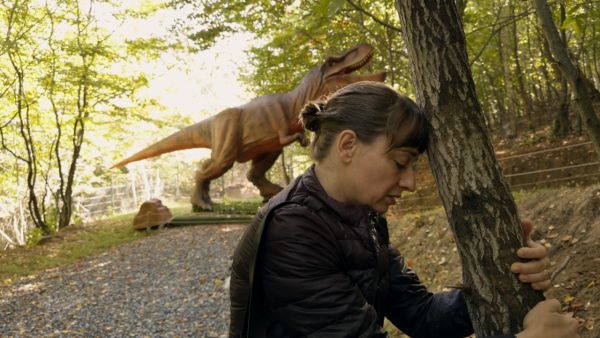
The film opens with a harsh, unsettling prelude of a man unhappily making his way through a hilly forest. He is what would once have been called a tramp—dirty and disheveled, carrying a load of bags and a burden of clear distress. He gasps, curses, and stumbles. He appears to have trespassed into some gimcrack, surreal woodland amusement park, as weird animatronic dinosaurs cackle and make clumsy movements in his wake. In town, the man begs customers seated at an outdoor cafe for money or a chance to work, attracting derision from members of Cluj’s aspiring Euro-class. This figure of misery finally makes his wretched way toward the boiler room of an abandoned apartment building, which is where our story will really kick off.
A woman bailiff, well-spoken and well-intentioned and accompanied by security guards, knocks on the door and urges the man to pack up and leave; the building is about to be developed into a boutique hotel. The man asks for a few minutes to sort out his belongings. While the bailiff and her team wait outside, he promptly kills himself. This shocking event sends Orsolya (Eszter Tompa), the guilt-stricken official, on an extended voyage of remorse. Too upset to go on vacation with her family, weepy Orsolya embarks on a series of conversations that search for meaning but also reveal false consciousness and self-interest—the price of living in a new Romania smelling new money. Throughout, Jude intersperses shots of shoddily designed and constructed new hotels and housing developments as a shrewd contrast to distinguished 19th-century Cluj and as a comment on the arrival of the greedy masses.
The director creates a relatable character in Orsolya, a member of Romania’s Hungarian minority climbing on the property bandwagon like everyone else. She is a kind, capable woman who, like many women, suffers from low self-esteem and second-guesses herself all the time. Comfortable in her job and marriage, Orsolya begins to challenge her values. In freewheeling Jude-an conversations whose interlocutors often reveal more than they intend to, Orsolya tells her tale of culpability in the man’s death to co-workers who respond with mocking, boneheaded platitudes; to a friend who shares a nasty scatological anecdote about a homeless man; to her mother, an irascible Hungarian who tosses off a tirade against the Romanian locals (“They took Transylvania from us just to ruin it. Stupid peasants!”); to a stern priest; and to a hyperactive and chatty bike messenger who is one of her former law students. A Jude movie would not be complete without an order of trolling, and the young man’s drunken tirades incorporating Zen philosophy, pop culture nonsense, and horny jokes serve up a hefty plateful. Luckily, Orsolya’s encounter with him ends up being one of the loosest, funniest parts of the movie. The conversations offer shifting perspectives on duty, faith, and the bald lack thereof in everyday life, not to mention an outlet for mouthy, colorful characters.
This sprawling, talky film raises some uncomfortable questions about privilege and human kindness. Its decent protagonist anchors the concerns and makes them feel real despite the hypocrisy around her (and Jude’s satirical swipes). Kontinental ’25 shows a gentler side of the director’s cynical worldview, ending with a silent montage of tacky-looking dwellings. In a callous Romania, it is a badge of honor to care for others, no matter how futile the task may be. And in a Romania that has endured dictatorship and dire poverty, the problem of ugly houses is a pretty good one to have.




Leave A Comment