
The golden age of movie satires will always be associated with the work of Mel Brooks in the 1970s (Blazing Saddles, Young Frankenstein) and the contributions of the ZAZ trio—Jim Abrahams alongside brothers David Zucker and Jerry Zucker—in the following decade (Airplane!, The Naked Gun, Top Secret!). Although these directors and their successive imitators kept looking for ways to laugh at cinema while simultaneously honoring it, very few have even come close to reaching the heights of those comedy classics. Last summer, the terrific reboot of The Naked Gun, a spoof movie about action flicks and crime films, restored some hope that perhaps this form of comedy is not entirely obsolete. This summer (and now maybe we can hope this becomes a seasonal tradition), another movie spoof arrives, riffing on the disaster-film genre with blockbuster ambitions, but with a variation never attempted before, or at least not on this scale: Make it gay, make it drag, make it unabashedly queer.
A self-aware and flamboyant trainwreck of snatched proportions and tucked private parts (if you recognize this particular lingo, this movie is—though hopefully not only—for you), Stop! That! Train! marries the shenanigans of the RuPaul’s Drag Race franchise with absolute cinema. Of course, this is a misleading and necessary exaggeration just to say that you’ll have a great time with this romp. While this is a World of Wonder production starring RuPaul and an inspired selection of former contestants and winners from the many iterations of his television show (all billed under their stage names), this film, directed by Adam Shankman, clearly wants to be more than an extension of Drag Race as a brand and to claim merits of its own as a hilarious and effective comedy.
The premise is simple: A high-speed train is heading straight toward a “stormaganza” (which is something like a big storm, but super gay), and everything conspires in favor of a disaster of epic proportions when nobody knows how to stop the train in time because, well, silly you, this is not about what’s logical but about what can be sustained as comical for a tight 90 minutes of entertainment.
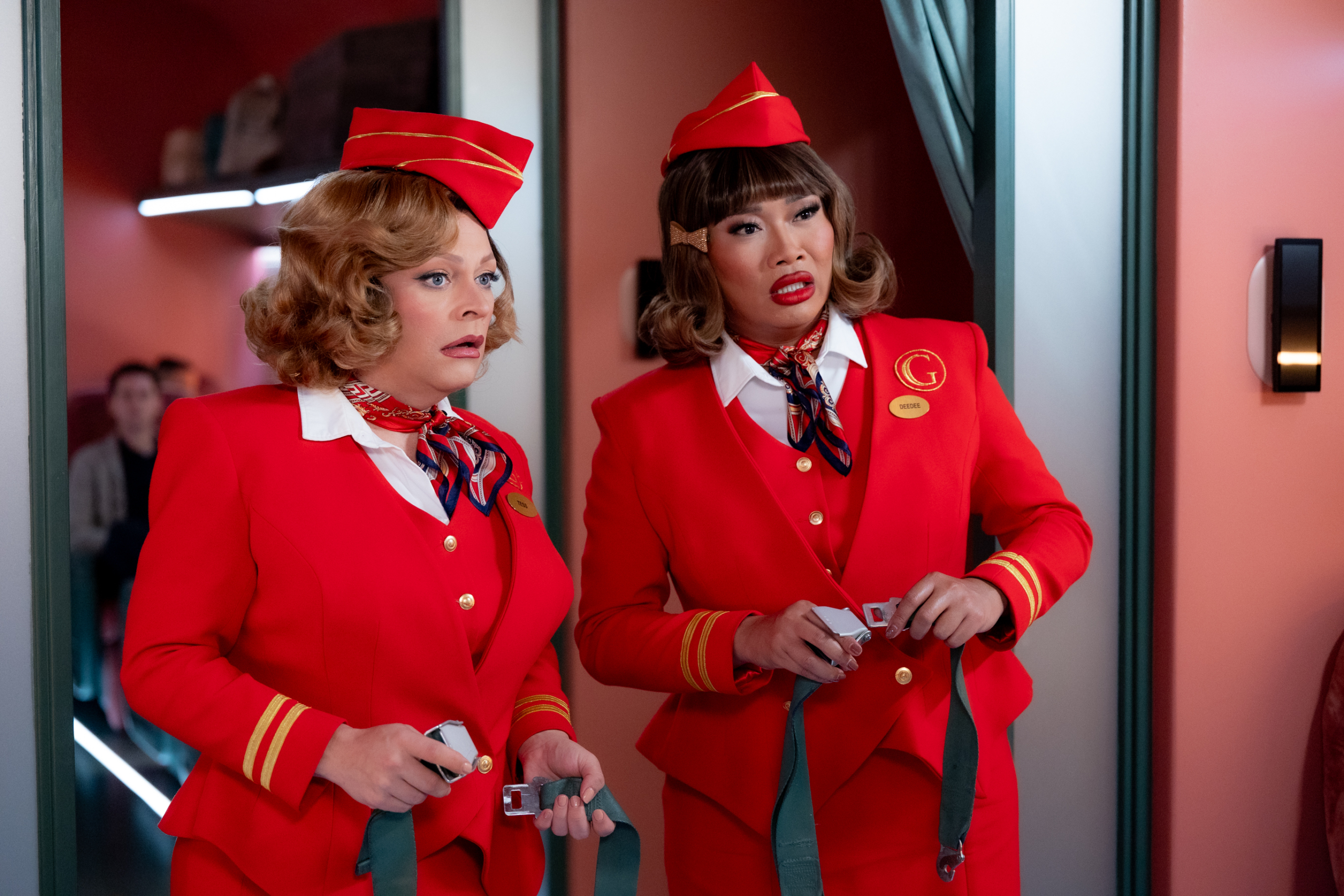
Tess (Ginger Minj) and DeeDee (Jujubee) are former Stank Rail hostesses and eternal best friends since their Train Hostess Academy days, now unemployed after the closure of Stank Rail—essentially the lowest rung in the glamour hierarchy whose pinnacle is the great high-speed Glamazon Express, boarded by millionaires and celebrities. It is staffed by Glamazonian girls, with the beauty, class, and distinction required to be the faces and bodies of a premium experience. Clearly, Tess and DeeDee feel they do not have what it takes to belong there, distinguished as they are by their bubbly personalities and clumsy behavior. These drag archetypes establish the separation between “comedy queens” and “pageant girls” in the cast.
But thanks to some providential circumstances (two last-minute vacancies that must be filled before the next train departs), Tess and DeeDee find their way aboard the Glamazon serving as replacements. There they encounter Amber (Brooke Lynn Hytes), a former classmate and bully, who is the leader of a mean-girls clique that includes Ayshleiygh (Symone) and Alli (Marcia Marcia Marcia). They welcome passengers with musical numbers and treat every train aisle like a fashion runway, walking with precision and confidence, not as mere servers but as queens who demand admiration and respect. In a drag tradition that predates Drag Race, the performers here exist as actual women rather than drag queens. The illusion is both maintained and challenged by how ridiculous they act and how fabulous they look.
Can Tess and DeeDee prove themselves worthy of belonging there? This is only one of the many subplots by the time the train loses its pilot thanks to a scorpion sting, while Cal (Brian Jordan Alvarez), the co-pilot left in charge, appears to have no idea how to stop a train—or barely how to drive one—despite his ranking as the number-one hunk in the magazine Conductors We Want to See the Dick of. In due time, here comes RuPaul to steal the show as President Gagwell, the first woman president of the United States, whose campaign was based entirely on vibes: “She fun.” The train crisis threatens to lower her approval rating on a thermometer where, once you reach the “Lea Michele in 2020” mark, it is officially time to worry.
However intricate the plot becomes (and however easy it ultimately is to predict), we are clearly here for the jokes. Oh, there are plenty of them, delivered at a pace of roughly one per minute, guaranteeing that if two or three fail to land, another one will soon have you cackling while you miss the next two expendable ones. The best gags are the running jokes, such as Sarah Michelle Gellar appearing as herself and being recognized by absolutely nobody, or Latrice Royale as Barbra, another Stank Rail casualty who somehow keeps finding different—and increasingly unexpected—jobs throughout the movie.
The humor is absurd and directly borrowed from the ZAZ formula, but always with a distinctly gay spin. Meanwhile, the craftsmanship on display is admirable when it comes to production design and costumes, though the shoddiness of the visual effects, even if they seem designed on purpose to accentuate the ridiculous premise, can occasionally be distracting (fortunately not enough to derail the enterprise). Shankman’s best film since Hairspray is polished and colorful like an eye-candy artifice. Yet it still carries something fundamental: the necessary queer joy capable of lifting spirits in difficult times.
Even if this represents the kind of carefully curated drag designed for mass audiences, occasionally lacking some irreverence and edge, time has demonstrated that even in its most accessible form it remains revolutionary and still uncomfortable for some viewers. Stop! That! Train! succeeds by creating good comedy that seeks to embrace all kinds of audiences equally, while reaffirming its vitality in being and feeling simply—with the double meaning of the word—gay.










Leave A Comment