
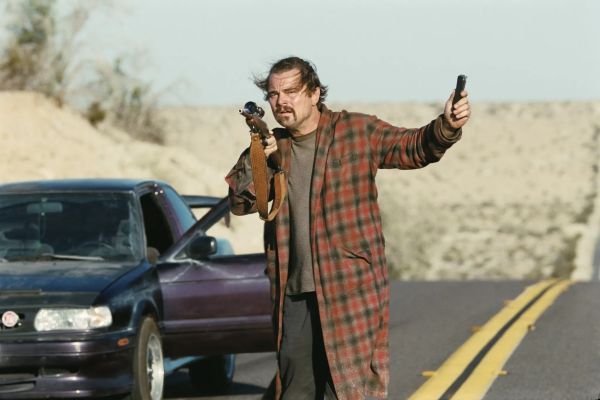
“Is that a swastika on that man’s face?” asks Doc Sportello, played by a gloriously befuddled Joaquin Phoenix in Inherent Vice, Paul Thomas Anderson’s first adaptation of a Thomas Pynchon novel. Sportello is undercover in an asylum that seems more like a cult or a spa, and he’s spotted a seeming skinhead in a circle of white-robed supplicants. “No,” responds his guide. “That is an ancient Hindu symbol meaning ‘all is well.’”
This is just one moment from a film that is underrated among Anderson’s body of work, a moment that encapsulates the atmosphere of unease that is its overall effect. The 1960s are over, forces darker than the Summer of Love are moving in the wings, and it is difficult for both Sportello and the viewer to identify just what’s going on.
Anderson’s new film, loosely suggested by Pynchon’s Vineland, does not want to leave viewers in a place of existential confusion, or even to take them there. It is set in a world of striking clarity.
The plot concerns the legacy of a radical group called the French 75 and takes place over the last 16 years. Revolutionaries engaged in combating injustice, partners Bob Ferguson (Leonardo DiCaprio) and Perfidia Beverly Hills (Teyana Taylor) carry out break-ins and sabotage, including taking out the electric power grid of a major city, after which they celebrate, having sex against a darkened cityscape—earlier, she masturbates while he builds a bomb. Colonel Lockjaw (Sean Penn), an arch-conservative officer, becomes entangled with the group when they raid a migrant camp he is in charge of, overpowering the guards. Soon, Lockjaw is in a position to bribe Perfidia: In exchange for sexual favors, he won’t expose her radical activities to the police. Perfidia becomes pregnant, gives birth, and then disappears. Bob is left with their child, Willa (Chase Infiniti), to raise on his own.
Cut to Willa as a teenager and Bob as a stoned, washed-up has-been, who live together off the grid. Meanwhile, Lockjaw seeks to join an Aryan brotherhood known as the Christmas Adventurers Club, and when he discovers they require him never to have engaged in an interracial relationship, he goes hunting to destroy the one potential evidence from his past. This sends Willa running and shocks Bob out of his complacency and into action.
By the end, if not the middle, Anderson’s intentions are quite clear. He wants to make a film about standing up to injustice, that insists there is hope in the future and that a better world is possible. The cast is strong, and the satirical elements (the Christmas Adventurers, for instance) are very funny. DiCaprio is hilarious and poignant as a stoned ex-radical forced to remember secret passwords for protection from killer cops, and Taylor is riveting as Perfidia. Anderson’s filmmaking excels in the faster-paced sequences, especially in two chase scenes, one by car and the other threading its way through a town where riots are breaking out. Not a single scene lacks energy. Nevertheless, the film falls short.
The revolutionary activity of the fabled French 75 is at once romantically conceived and rendered with a remarkable lack of ambiguity. They are an armed militia with the kind of high-grade weaponry and a level of organization that, I’m guessing, eclipses that of the Weather Underground. It is not clear what they stand for, except in the blandest, most general terms. They liberate camps of migrants. Fair enough. They are against fascism. Again, fair enough. Anything else? They blow up courthouses, which, the way it is framed, appears to be an intrinsically valuable action in and of itself—a concrete goal is not necessary. Also, they rob banks. To give to the poor? Actually, no: It’s to pay for their artillery. Guns, bombs, and tear gas, all of which are used by the French 75, are near guarantees of unintended consequences, and here there is only one (involving Perfidia). In short, the French 75 are treated with about as much reality as a superhero team.
The film also frantically skirts over action and scarcely developed characters. Anderson has proven himself adept at handling a wide variety of characters and bringing each of them brilliantly into light in previous films. Here, he brushes past them so quickly, or portrays everyone so broadly, that no role, scene, idea, or plot element is fully explored.
Previous Anderson films are also remarkable for the way they elude easy definition, but in One Battle After Another, everything is exactly as it seems. The good guys are the good guys, the bad guys are the bad guys, and it is all too easy to tell who is who—few can pretend we actually live in a world that is so easily understood. (I will not list the ways, though the chaos of the internet is a fine place to start.) Oddly enough, Inherent Vice, though it is set decades in the past, feels more contemporary, more truthful, and more hopeful, because uncertainty has a presence there. It is hard, these days, to trust a vision that does not accommodate uncertainty.
The consensus on this film appears to be that this is the work of a master filmmaker at the height of his powers. I would argue that this is the work of a filmmaker who has neglected to trust all of his powers. It would be easier to accept if he had never set the standard so high.





Leave A Comment