
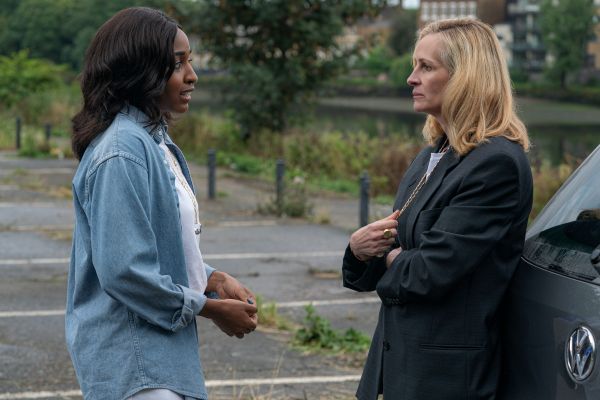
Luca Guadagnino is known primarily for languid, sensual films, so it’s intriguing to see a chillier work from him where sensuality is continuously blunted. Still, here are some of his pleasurable trademarks, including elaborate sets and chic wardrobes.
In an early scene, perhaps illustrating their lack of control, Guadagnino and cinematographer Malik Hassan Sayeed film the characters as though they are drowning in those sets and clothes. Yale philosophy professor Alma Olsson (Julia Roberts) and her psychiatrist husband, Frederik (Michael Stuhlbarg), are throwing a party. Alma’s department colleague, Hank (Andrew Garfield); Alma’s friend and personal psychiatrist at Yale, Dr. Kim Sayers (Chloë Sevigny); and eager PhD candidate Maggie Price (Ayo Edebiri) are all together drinking—a lot. Alma and Hank are on the sofa facing everyone, with Hank leaning back casually, his legs touching Alma’s side. They smoke cigarettes and pontificate philosophy. Alma wears one of the oversized blazers she wears throughout, her blond hair coiffed in a sleek 1950s pageboy that gets more unraveled as the story progresses. Sayers, though, dons a short, tightly curled hairdo and dowdy suit. (It’s impossible to make the perpetually cool Sevigny look dowdy and uncool.) All around them are art pieces, lavishly brown-paneled walls, and drapery.
The party is one of the rare scenes that is partially filmed from Maggie’s perspective. Alma calls her “honey” (an odd thing for a professor to say) and directs her to use the guest bathroom. It’s there where a snooping Maggie, looking for toilet paper, discovers a taped envelope inside the top of a cabinet. The moment is so well set up that I wondered at first if the envelope was planted, especially since Alma is revealed as so observant and cunning.
Yet the script, written by debut screenwriter Nora Garrett, is not as tricky nor as mysterious as it wants to be. It isn’t really an ensemble piece, either, as advertised in its publicity rollout and diamond cutouts of glum, serious faces on its poster. Instead, it’s a character study of the tormented, thorny Alma, played to the hilt by Roberts, in her best performance since her nervy turn in Mike Nichols’s Closer. It’s always exciting to see her tackle a complicated, prickly character like Alma after being pigeonholed with the trivial moniker “America’s Sweetheart” in the past.
Early on, an incident splinters Alma, Hank, and Maggie. On a rainy night, Alma arrives home to find Maggie waiting for her to haltingly reveal that she was assaulted by Hank (on whom Alma has had a crush). From this point on, the story, and Alma’s preening disposition, begins to break down. It’s perplexing why the filmmakers often withhold Maggie’s experience since we see so much of Alma’s. Unfortunately, the lack of focus on her, and others in general, sometimes reduces the dialogue to a banal he-said, she-said debate. However, the storyline is more rewarding in depicting how Alma responds to the events around her. (Guadagnino and his editor Marco Costa cut to little details and gestures to make them feel seismic—as Maggie reaches out to Alma’s hand for comfort when telling her about Hank’s assault, Alma’s hand briskly retreats.)
The film throws in a few jarring details that suggest satire or social commentary, but none of them are probing or significant (the distinctive Woody Allen font of the opening credits; Sayers’s comment on how “bold” and cool it is to hear far-right Morrissey playing on a campus bar’s jukebox). I recoiled a bit at Alma’s dismissiveness of a trans character, Maggie’s non-binary partner, Alex (Lío Mehiel, great in 2023’s Mutt), though Guadagnino is intuitive enough to show their hurt reaction—it doesn’t become a joke.
The acting and crafts on display are excellent, save for the usually winning composing duo Trent Reznor and Atticus Ross’s overly fussy, misfire score. The sound of ticking clocks, the halting piano cues, and abrupt, loud baleful horn notes (perhaps to mimic Alma’s crippling physical ailments) are almost comical. The film was shot in London, yet feels as if it was filmed in New Haven. The sets were impeccably designed to mimic campus locales. A later scene between Hank and Alma in her enviable cold, spare pied-à-terre writing studio is a vivid contrast to the early party scene in Alma’s roomy, overstuffed apartment.
The film provides a showcase for Roberts, but the supporting players are strong as well. Stuhlbarg, in particular, injects the tension with some needed humor, constantly blasting music—one of the seemingly few joys Frederik revels in. While having different personalities, he and Alma come across as a couple who have been together for a long time, respecting, adoring, and sometimes tiring of one another. Edebiri excels in slippery unease, despite the script’s lack of character development. The same goes for Garfield, though it’s refreshing to see him stretch into more ominous territory.
After the Hunt was the opening film at the New York Film Festival. It’s subpar in quality compared to recent openers Nickel Boys and May December, but still remains an involving and visually detailed Ivy League drama from a provocateur filmmaker, with a vigorous performance at its center.



Leave A Comment