In its 15th year, the Museum of the Moving Image’s First Look festival offers an array of eclectic cinematic offerings. These three compelling documentaries are examples of the slate.
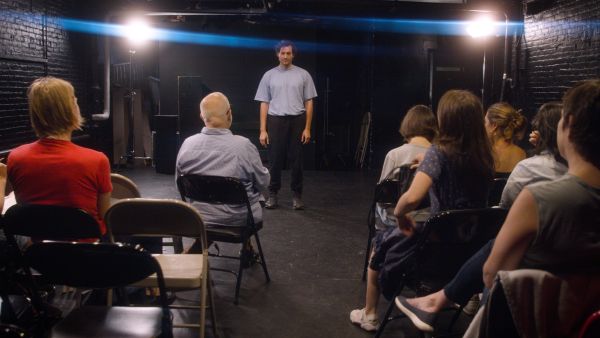
It’s both fascinating and a little uneasy to watch 35-year-old Charlie Birns’s erratic journey in his layered The Whole World Is a Lie. It begins as a straightforward documentary about a New York City method acting class—for which Birns foots everyone’s bill—led by a fiercely intuitive, mercurial instructor, Tony Greco, who ultimately emerges as the film’s most compelling figure. Birns doesn’t have a long acting resume and has taken the class for two years. His original intentions were to relay the profound, spiritual effect the class has on him. Eventually, under bright lights and the scrutiny of cameras, many in the class start to question their participation in Birns’s piece (one mentions not wanting to be an extra) as well as his opaque intentions, sometimes becoming hostile. These volatile, confrontational scenes are by far the most gripping, revealing tensions between subject and director (and crew) and the blurred lines between what’s real and what’s performance.
Like his performance in an ongoing class run-through of a scene from Chekhov’s Three Sisters, Birns comes across as a wandering, lost puppy, perhaps harboring illusions of grandeur but rarely communicating anything succinctly. A classmate derides his project as solipsistic, though it’s more as if he’s unsuccessfully trying to connect with others, including his distant father, who disapproves of his lifestyle and of wasting money on this film.
In an odd way, the documentary’s muddled nature is what makes it absorbing; it’s less effective when it stretches for clarity and profundity. It aims for a sense of closure toward the end, especially concerning Birns’s reckoning with his father, who often repeated the film’s titular phrase during Birns’s childhood—a lifelong haunting. Birns also reaches out to various scientific and spiritual figures, including a biologist, an ethnobotanist, a movement researcher, and a Taoist grandmaster who offer philosophical asides on consciousness and existence. These moments feel like gossamer window dressing around the film’s true hook: his participation in the class, both in front of and behind the camera.
In a more traditional vein, Rachael J. Morrison’s Joybubbles follows the charming Joe Engressia, who legally changed his name to the more whimsical Joybubbles in 1991 at age 42, apt for the childlike spirit he inhabited. The film traces his life, from being born blind in Richmond, Virginia, in 1949 through the frequent family moves of a difficult childhood—which included sexual abuse at a Catholic school for the blind—to adulthood, when he was arrested and served a brief jail stint for phone fraud.
At age four, Joe became obsessed with all aspects of the telephone, finding comfort in just listening to the dial tone. Joe was often lonely (a favorite word that he elongates aloud at one point), craving communication and connection. With perfect-pitch whistling, he learned how to tap into the phone system to call long-distance numbers.
As an adult, during the peak era of “phone phreaks,” who subverted corporate monopolies like AT&T by hacking into the phone system, Joe accessed a top-secret military line, prompting his arrest. Later, he set up his own number under the alias of Zzzzyzzerific Funline (so that he would be listed as the very last name in the phone book), leaving life-affirming messages for callers and giving his direct number at the end for anyone who wanted to talk to him directly.
Morrison’s documentary is a lovely tribute to Joybubbles, an underappreciated genius overlooked in his time. It’s also an elegy for a bygone era of analog telephone culture—switchboard operators, thick phone books, and costly long-distance calls—rendered through stock footage and archival recordings. Even though the splendid retro visuals are effective, the film, largely narrated by Joybubbles and those who knew him, could just as easily work as a purely aural experience.
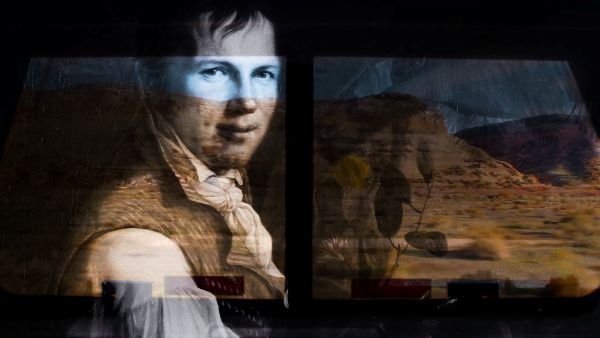
G. Anthony Svatek’s poetic Humboldt USA pays homage to the influential German scientist Alexander von Humboldt, a figure largely forgotten by many Americans. His breakthroughs in ecology led to his name being attached to species he discovered, as well as to American parks and expressways (including one in Buffalo, New York, where residents are shown fighting to restore it to a more natural state).
One of the film’s enthralling aspects is its interplay between the natural and man-made worlds. Beautifully photographed and edited by Svatek, it illuminates the dissonance, visual poetry, and sadness of environmental disregard, especially in an era of rapidly changing technology. Traveling to sites throughout the country bearing Humboldt’s name, the film also introduces those working to preserve the environment, including a spirited Redwood National Park ranger, Griff Griffith, who creates online educational videos, and wildlife experts in Nevada attempting to protect bighorn sheep.
At one point, the filmmakers take a detour to a Scheels sporting goods store, a surreal retail space that offers a Ferris wheel alongside guns and ammo, as well as eerie, animatronic mannequins of historical figures (including President Reagan). This mishmash of consumerist excess and superficial historical memory forms part of Svatek’s thesis.
Occasionally Svatek addresses Humboldt directly in voice-over. While this device is somewhat distracting, the film is so vivid and complex that minor flaws are easy to ignore. The result is a standout, but all three films offer rich explorations in under 100-minute runtimes and are highly recommended.
First Look runs until May 3 at the Museum of the Moving Image.




Leave A Comment