
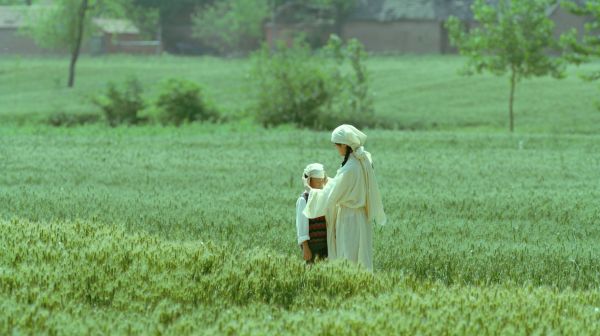
Sharply observant, Huo Meng’s Living the Land centers on the great changes that rural Chinese life underwent in the early 1990s, mainly through the eyes of young Chuang (Wang Shang), who lives in the small village of Bawangtai with his extended family, which tends a wheat farm just like it has done for generations.
In 1991, the villagers are hearing about plentiful and decent-paying jobs in large cities that are becoming quickly industrialized, so Chuang’s parents and two older brothers leave Bawangtai—located in Henan province in Central China’s Yellow River Valley—to search for gainful employment, leaving 10-year-old Chuang with his farming uncles, who are busy with the wheat crop and so leave him to his devices.
Chuang is uneasy about his new household; he still wets his pants, and he’s bullied at school, where he comes to the aid of a cousin who is mentally disabled and an object of derision by other classmates. At home, Chuang becomes closest to his crotchety but still vigorous great-grandmother, Great-Grannie (Zhang Yanrong), and his 21-year-old aunt Xiuying (Zhang Chuwen), who shares her young nephew’s uneasiness. She is in love with a local schoolteacher but is being pressured to accept the hand of a wealthy young man who has important political ties.
Huo sensitively records how Chuang deals with living without his parents and siblings while meticulously observing the unhurried passing of the seasons, beginning with a death in spring and ending with a death the following winter. Ancient rural customs and rituals like communal meals and wedding celebrations are also highlighted. None of this is made into a big show; the elliptical narrative features Chuang as its anchor but leaves room for a large canvas of how these farmers, who have worked the soil for many generations, are very much a part of the natural world.
With his expert cinematographer Guo Daming, Huo creates exacting portraits of nature and humans interacting in static long shots or with a slow-moving camera, whose subtle choreography of the inhabitants’ movements amid these colorful fields is reminiscent of similarly dazzling images in films by Miklós Jancsó or Andrei Tarkovsky. Huo is not aping those masters but rather pointing out how the repetitive work of tilling the soil and cutting the wheat has been occurring for centuries, even as the industrialization of a modernized China is encroaching but still out of the frame.
Huo also illuminates how the Chinese Communist Party affects day-to-day existence. The country’s one-child policy is evoked when Xiuying’s sister-in-law is expecting her third child. When she is called in by authorities for the pregnancy check women are given regularly, the family sends Xiuying instead, which buys them some time. But later, when the young woman gives birth, it leads to a heavy fine for violating the law.
In its deliberate pacing and characterizations based not on conventional plotting but by the very rhythms of the seasons, Living the Land makes its points about the loss of a certain way of life in the face of inevitable modernism gently and memorably.





Leave A Comment