
The excitement that comes with the 63rd New York Film Festival is immense for any film lover. Having the chance to see highly anticipated films first is enviable, even when some are hitting theaters soon. Meanwhile, what generates the most buzz might make us lose sight of the refreshing “Current” selection of hidden gems and undistributed films that deserve attention.
Let’s dive into three highlights. We’ll find the much-anticipated debut of a director who has helped redefine the artistic image and identity of Latin music through his music videos, an elliptical time-travel experience unlike any other, and a new production from the Argentine filmmaking collective El Pampero Cine with another delightfully absurd and delirious work—this time with a shorter runtime than usual.
Barrio Triste is the anticipated feature directorial debut of Colombian-American photographer and filmmaker Stillz, who is already highly recognized thanks to his admirable work directing music videos for some of today’s most renowned Latin artists, as well as collaborations with international pop stars (Dua Lipa, Katy Perry). His work on these videos, specifically in South America, has radically helped redefine the artistic identity of music on the continent. Where the typical formula of partying in the club or near the beach used to be all that could be seen in most reggaeton videos 10 years ago, Stillz has opted for wilder, unpredictable concepts and ideas, in co-authorship with musical artists willing to push the envelope. Just take a look at videos like “Yo Perreo Sola” (by Bad Bunny) or “Vampiros” (by Rosalía and Rauw Alejandro).
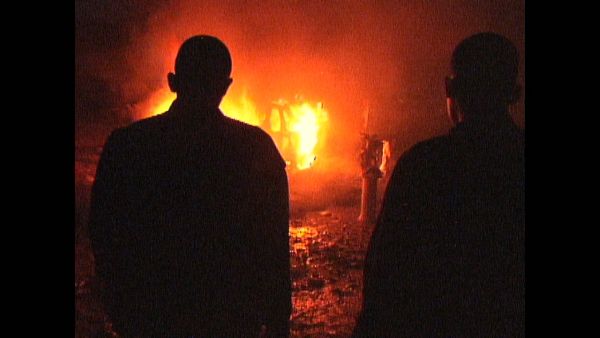
The first-person camera POV gives Barrio Triste a documentary flavor (and partly recalls last year’s Nickel Boys visually). Technically, it’s a highly subjective found-footage movie, starting with a sensationalist journalist reporting alleged UFO sightings, whose camera is stolen by a group of teenagers while filming his report. That video camera captures what the group then does and says, including a high-adrenaline jewelry store robbery sequence and a subsequent high-speed car getaway. By this point, the kids are fully immersed in a life of crime with no redemption (someone gets killed during the robbery). The camera also records their testimonies, where they reveal that even if uneducated, they possess the intelligence and depth to lament their lost innocence.
Later on, Stillz turns realism upside down with hyperkinetic supernatural elements. I won’t reveal what happens, but it’s both terrifying and magical—as if Spielberg channeled Gabriel García Márquez. Backed by an entrancing score composed by Arca (a transgender Venezuelan woman, one of the most interesting and experimental pop stars out there), Barrio Triste is a marvelous case of purposeful style gladly overcoming the routine in these kinds of coming-of-age stories.
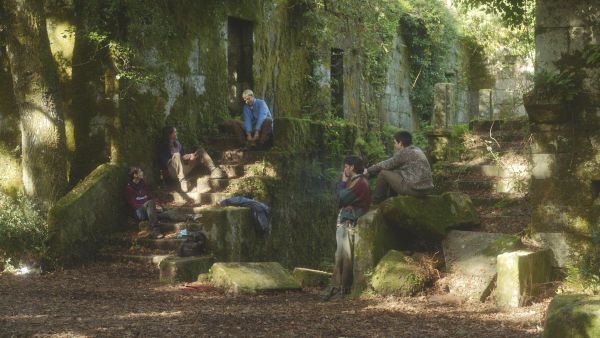
From a well-seasoned director like the Spaniard Gabriel Azorín comes Last Night I Conquered the City of Thebes, a co-production between Spain and Portugal filmed in thermal baths on the border between both countries that date back to the Roman era. This tourist attraction remains untouched by the passage of time, as if it were a portal to an old world. The director thus transports us from modernity to antiquity through subtle camera movements and changes of wardrobe that are enough to create an elliptical time-travel journey. Azorín intuitively explores how there isn’t much difference between the youth of today and that of the Roman Empire when it comes to undressing and enjoying a moment of leisure and relaxation, while physical nakedness gives way to emotional vulnerability.
A group of young tourists strolls among the ruins and later enjoys the aforementioned thermal waters. As night falls, the film captures a long conversation between two of them, immersed in rock-carved individual pools next to each other. From their discussion, both are aware that this trip could be the last opportunity for a friendship that will undoubtedly be affected by the responsibilities and decisions the future holds (college, work, adulthood). Then, in a remarkable transition, Roman soldiers appear, removing their tunics and immersing themselves in one of the larger pools. A young soldier will meet another boy his age—who may or may not be his lover—in what becomes a devastating farewell, portrayed with tense restraint. One intends to escape the responsibility of going to war and flee elsewhere, while the other insists on staying and fulfilling his duty.
Come as a voyeur to enter a sensual world of thermal springs and stay for a unique work that digs deeper into friendship between men and what happens in the rare spaces allowing men to be vulnerable and grant themselves the freedom to share intimacy. There’s an interesting border here between the homosocial and the homoerotic that keeps us guessing and waiting, but that turns into something more rewarding. Universal truths across eras also bring to the surface an undated longing: the desire of men to sincerely open up among themselves beyond the conventions, demands, or responsibilities that swamp them. Last Night I Conquered the City of Thebes is a rare, delicate film unconcerned with dramatic conflict that reaches something deep and spiritual.

Directed by Alejo Moguillansky, the Argentinian production Pin de Fartie, a wordplay that directly refers to Samuel Beckett’s play Fin de Partie (Endgame), is an adaptation of the Beckett play—until it isn’t. It reimagines, betrays, honors, and deconstructs it scene by scene. We get it (re)played and (re)lived in a modern setting. Sequences feature a blind man and a woman who takes care of him in a remote place in Switzerland. Two actors meet one night a week to rehearse the play as the aforementioned characters and perhaps, gradually, fall in love with each other without ever being willing to confess it. And a son visits his elderly mother, and as usual and at her request, he reads Beckett’s play to her. He later wonders if there’s a hidden message she wants him to learn. At the same time, all this is framed within a recording session between a director and a composer discussing musical options and adding pertinent songs to serve as narration.
Like all good productions from El Pampero Films, there’s a lot to ponder but also an effortless flow of refreshing creativity. Pin de Fartie is slimmer and more streamlined than something gargantuan like La Flor (14 hours of runtime), but still unique (less than two hours). This is the work of a group of artists willing to reconsider new ways of expanding and testing the language of cinema beyond what’s commercial or mainstream-appealing, yet without causing boredom or puzzlement. Currently, there’s nothing else quite like their movies, which are more accessible than they sound, though there’s not enough critical coverage of these works. Fortunately, the New York Film Festival has become a faithful space of support for them. I anxiously wait for what this collective will do next.









Leave A Comment