
Less than half an hour into Rose of Nevada, I thought to myself, “This movie could be about anything.”
Of course, that is an exaggeration. The film begins with a concrete, if cryptic, event: A long-lost fishing boat drifts back to the harbor of the Cornish town from which it first set out. The place, though unnamed, is also concretely observed with minute and mundane details. The pelting rain, the holes in the roof, the cobblestones, and the modest living spaces are all photographed evocatively yet matter-of-factly, without much attempt to draw a specific mood out of them. All shot on 16mm with a hand-cranked Bolex camera.
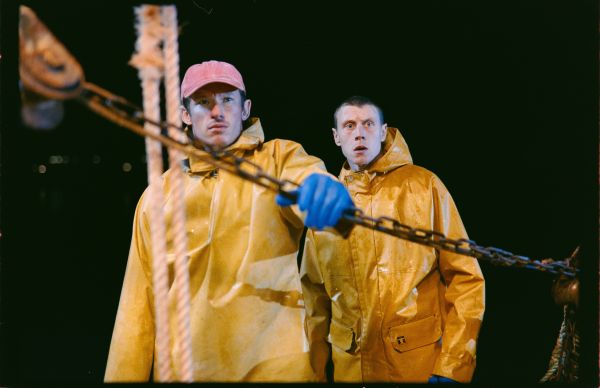
The import of the ship’s return becomes clear enough: Two young men died on it. One was the son of a couple who still survive, and the other man was a husband and father. Although a few of the older residents utter some mystic statements (about long-lost sons coming back), the behavior of most inhabitants is pretty normal. And so, when Nick (George MacKay) and Liam (Callum Turner) set out with the grizzled Murgey (Francis Magee) to bring some fish back to shore, it really feels like any number of narratives might develop. That being said, the town’s overwhelming atmosphere is one of sadness and decrepitude.
This is one way of saying that I walked into this film unusually blind, not having read so much as a plot description, and not realizing that the director was Mark Jenkin, creator of the cult folk-horror Enys Men. Knowing or not knowing the upcoming supernatural twist should not ultimately affect the viewer’s enjoyment. This film’s (mostly) subtle hand, the restraint of its beginning, and the carefulness with which it illuminates pedestrian aspects of its world make this ghostly drama an odd and unlikely success.
Nick and Liam, upon their return from their fishing trip, discover that they have come back to a version of their town where the tragedy (the drowning of two fishermen) never occurred, and their sad and broken town is now prosperous. Yet not only have they reentered a happier version of the ’90s, but they have taken on the appearance of the disappeared fishermen. Thus, one is expected to be a son to his two happy parents, and the other a husband and father to the wife and daughter who have been waiting for him. While Liam somewhat numbly accepts the situation, Nick (who has left his own wife and daughter back in his own time) struggles to get out.
It might seem that, once the tale takes this turn, a foreboding and claustrophobic tone might take over, and the narrative might escalate into horror. There is an element of that—a modest selection of omens commences as soon as the two young men depart. Still, Jenkin never quite loses the quality of attention which he displays in the beginning. The highlighting of minor aspects of this seaside hamlet, the compassionate gestures, and the visual motifs (like the dumping of nets of fish out onto a boat’s deck) all serve to illuminate the sense of interdependence crucial to the townspeople. And the respective roles the two fishermen assume, that of absent husband and absent son, make the film as much a disquisition on the ambiguous nature of responsibility as an eerie tale of finding oneself lost in an alternate reality.
If sometimes Mark Jenkin can get a little ham-fisted with ancient old-timers uttering prophetic statements (a tendency which sometimes undercuts the film’s subtlety), the overall design is such a welcome surprise that this engrossing little gem will be worth revisiting.






Leave A Comment