
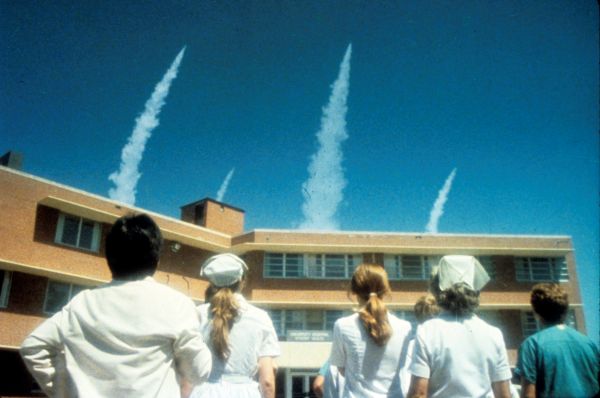
In 1983, the Cold War was heating up. President Reagan’s bellicose attitude was encapsulated by the phrase “evil empire,” which he used to describe the Soviet Union. So when the ABC television network aired the movie The Day After on November 20, 1983, it was a momentous occasion, at least according to Jeff Daniels’s illuminating documentary.
The Day After, which dramatized a nuclear attack on Middle America and the utter devastation it causes, was set and shot in Lawrence, Kansas, just outside Kansas City—as close to the literal middle of the country as one could get.
As the chatty talking heads who made the TV movie recount—including director Nicholas Meyer, writer Edward Hume (not Tim Hume), producer Bob Papazian, and ABC executives Brandon Stoddard and Stu Samuels—the film was conceived as a dramatic response to the escalating nuclear arms race. But the network executives were unsure whether something so controversial could even air during primetime, especially over two nights. It was originally envisioned as a four-hour miniseries but was eventually condensed into a single three-hour broadcast, largely because ABC was worried about a lack of advertisers—many were skittish about buying ad time for a project that could be a ratings flop.
As Meyer recalls with sardonic humor, the production was constantly interfered with by ABC executives and censors, who insisted that no blood or other graphic effects of nuclear war be shown. Meyer ultimately lost final cut after pushing back too forcefully, according to Samuels, who also notes that ABC wanted massive ratings—Hollywood’s perennial bottom line—and took a risk by airing a film that might be considered too disturbing for families gathered around the TV on a Sunday night.
Ted Koppel discusses the late-night special he hosted following the film’s premiere. The show, Viewpoint, brought together experts from across the political spectrum to debate the movie’s implications. Guests included scientist Carl Sagan, conservative pundit William F. Buckley Jr., former government officials Robert McNamara and Henry Kissinger, Army General Brent Scowcroft, and Holocaust survivor Elie Wiesel. The latter rebutted Buckley’s cynical characterization of the film as pro-Soviet propaganda, saying, “I know the impossible is possible,” in reference to the Nazi concentration camps.
Did The Day After actually influence U.S. nuclear policy? Daniels and the film’s creators suggest it did. It was an enormous cultural event, watched by an estimated 100 million viewers in the United States alone, and later broadcast in 17 countries, including the Soviet Union. It challenged the popular notion that nuclear war was survivable and even shook Reagan, who wrote in his diary after a screening at Camp David that the film was “very effective” and made him reconsider his stance on nuclear weapons. The Day After may not have been the primary reason Reagan and Soviet leader Mikhail Gorbachev signed the Intermediate-Range Nuclear Forces (INF) Treaty in 1987, but it undoubtedly helped move public consciousness—and perhaps political will—toward reducing nuclear stockpiles.




Leave A Comment