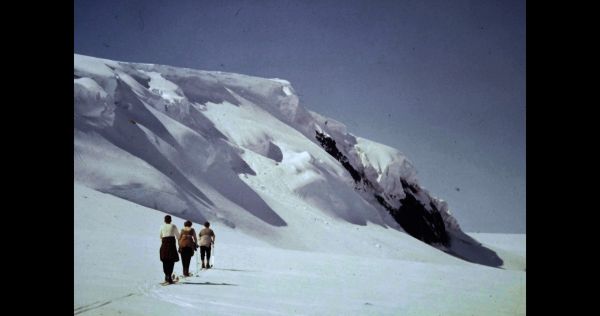
When I was 10, my family and I went to Alaska and visited a glacier. I can remember quite clearly the rickety boat where we struggled to keep our balance and the way the sights impressed everyone, and I have a vague recollection of the glacier itself and the deep rumbles emanating from it. Yet, being 10, I was much more concerned with the icebergs floating close to our boat, since the captain had allowed me to shove them with a boathook. I am sure that the glacier is much smaller now, and it’s one of my regrets that I was not alert to truly experience it.
Icelandic writer and poet Andri Snær Magnason luckily had many chances to become intimate with glaciers, for they are, for the time being, as much a part of his home as its many volcanoes. However, time, as he cannot help but notice, is running out: In 2014, he was asked to write the text on a commemorative plaque for Glacier Ok, the first Icelandic glacier to be declared dead. In Time and Water, a new documentary by Sara Dosa, Magnason seeks to create a time capsule in which glaciers still exist though they are disappearing. “I want you to know glaciers as my grandparents did … as I do,” he says.
This documentary, however, is as much about Magnason’s reflections on his family as it is about Iceland’s environment. Two of his grandparents were among the first to measure and map the glaciers—their honeymoon was spent doing so. His other grandparents also had a deep relationship with these monoliths of ice. Close-ups of and observations on these wonders of nature are intermixed with home videos of his family members at various points in time and his thoughts on the mutability of all he holds dear. He finds a metaphor for the loss of his grandparents—both their lives and their memories—in the glaciers that are gradually melting.
Whenever the focus is on the ice, the results are absorbing. Magnason details the degree to which these ancient glaciers literally contain long stretches of geologic time: the dust of volcanoes, various pollens, and signs of erosion dictated by floods and winds. One glacier even contains birch logs, suggesting the source of folktales about a fairy who comes from a wood hidden within the ice. Sequences of snow blowing across glacial expanses, shots of ice observed up close, and many other glimpses of the natural world prove fascinating and difficult to resist.
Though the metaphorical link is clear, Magnason’s meditations on his family do not lend the film the resonance its makers strive for. At so many moments when the film feels ripe for expanding its lens—perhaps going into greater detail about what the glaciers provide for Iceland’s environment, or how environmental changes might impact its citizens—he swerves away and meditates on how much his daughter has grown. Certainly, it is moving to see his family (especially the grandparents) age over the years. Yet there comes a point at which Magnason takes a step back and assesses that all of his attempts to capture time on camera, regarding both family members and glaciers, are indicative of a refusal to let things go. In doing so, he comes close to conflating an environmental crisis with learning to accept personal loss. While climate change does not show any sign of slowing down, I’m still not sure it makes sense to discuss it in such terms. Add to this that, in a relatively short running time, Magnason manages to be both redundant and obvious. I was moved the first time he mentioned how he always assumed that glaciers were permanent, but by the end … you get the picture.
Magnason’s plaque for Glacier Ok, dedicated to future generations, reads: “Ok is the first Icelandic glacier to lose its status as a glacier. In the next 200 years all our glaciers are expected to follow the same path. This monument is to acknowledge that we know what is happening and what needs to be done. Only you know if we did it.” This statement carries an undeniable impact on its own. By the time we finally see these words (just before the end), it is all too clear the extent to which Magnason was distracted from the context that would truly give them weight.



Leave A Comment