
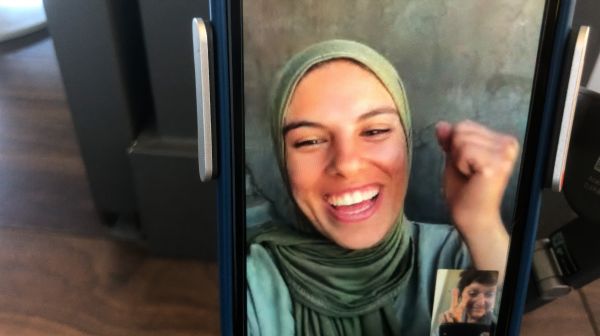
Intent on documenting the war in Gaza, Iranian director Sepideh Farsi traveled to Cairo hoping to enter the war zone from the Egyptian border, but the Israeli blockade prevented her from doing so. Instead, Farsi went to plan B, which comprised most of her, at times, powerful documentary. Speaking with refugees at the border, she is introduced to 24-year-old Palestinian activist and photojournalist Fatma Hassona, who lives in northern Gaza with her family and provides constant, tense updates about life in the bombed-out occupation zone through video calls with Farsi.
The women’s conversations began in the spring of 2024, seven months after the October 7 massacre and hostage-taking by Hamas, and continued for a year, until, on April 16 of this year, Hassona and her entire family were killed by an Israeli bombing raid, just 24 hours after Farsi told her this very film would be shown at Cannes.
That’s not a spoiler. In fact, knowing that Hassona dies makes Farsi’s film even more poignant. The articulate Hassona (she speaks nearly perfect English along with Arabic) is a charming, intelligent, and always positive presence onscreen. She describes to Farsi the unrelieved horrors that are part of daily life in Gaza, like the indiscriminate killing of civilians—including her own family members—and she also mentions small things that she misses, like the taste of chicken or a small piece of chocolate. The memory of the latter causes her to beam a smile that shows off how cheerful she is even while she’s in such a pitiless situation.
Farsi smartly punctuates their calls with glimpses of Hassona’s artful photography, many trenchant images that record the devastation of Gaza unflinchingly while also highlighting how resilient the people there are, about which Hassona says proudly, “We are strong and brave.” We also hear both a poem and a lovely song she wrote. Although the Israeli armed forces are the obvious villain here—both women have strong words about the relentless bombing, which can be heard in the background at times—there’s a moment when we realize Hassona and others are not pro-Hamas.
Farsi asks her about Yahya Sinwar becoming Hamas leader in the fall of 2024 (he’s killed shortly after by a targeted Israeli attack). She answers that the election was a joke and that no one she knows wants him as their leader—there is no more discussion or further explanation. The events of October 7 are also briefly touched upon. Though Hassona still has that same radiant smile, beneath is a resignation, believing that no one really cares about the Palestinians’ plight.
Throughout, the video calls are subject to the vagaries of bad internet in Gaza; Hassona’s image often freezes, her audio drops out, or the call is cut off altogether. These unwanted instances of literal disconnection become a metaphor for how fragile real communication can be. Indeed, Hassona admits to feelings of depression because of her increasingly untenable situation living in a war zone with little food and even less chance of making it out alive.
When she smiles and paraphrases a quote from The Shawshank Redemption, “Hope is a dangerous thing,” Hassona still understands that one must remain optimistic, even in the depth of despair. Besides documenting the state of the war over the course of a year, Put Your Soul on Your Hand and Walk stands as a moving memorial to a brave woman who lived her short time on earth almost to the fullest.
Leave A Comment