
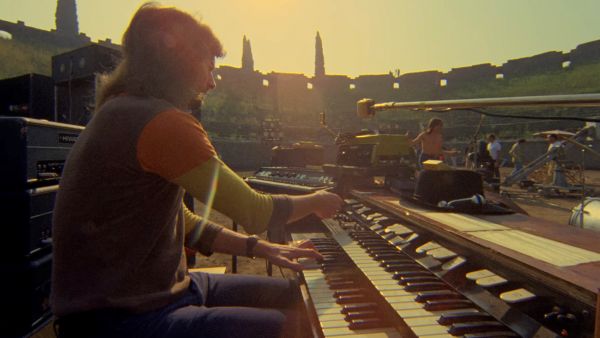
Originally released in 1972, Adrian Maben’s concert film Pink Floyd: Live at Pompeii has been digitally restored and remixed for IMAX screens. Its pristine picture and enveloping sound make this a fascinating musical excavation—an important document of Pink Floyd (guitarist David Gilmour, drummer Nick Mason, bassist Roger Waters, and keyboardist Richard Wright) performing live in 1971 before the release of 1973’s The Dark Side of the Moon propelled the group into the rock stratosphere.
The film comprises sequences of the band performing songs from their recent albums Meddle and A Saucerful of Secrets, shot by Maben and an array of sound and camera operators in the ancient Roman amphitheater in Pompeii, as well as later in a Paris studio—power problems cut filming in Pompeii from five to three days. Also included is footage from the 2003 director’s cut, shot at Abbey Road Studios, where the band records The Dark Side of the Moon and sits for interviews, snippets of which are interspersed throughout.
Since the Pompeii concert footage makes up only about an hour, the studio sections—shot a year later—stretch the film to 90 minutes. Eagle-eyed viewers will notice that during some songs, the camera focuses heavily on one or two members at the expense of the others. On the rousing instrumental “One of These Days,” we mostly see Mason drumming for the entire song, with Gilmour on slide guitar beside him in a few shots. Waters and Wright are entirely absent. (That footage in particular puts the lie to any notion that Mason was not a superior musician; he bangs away at his kit quite impressively.)
Maben uses visual effects that may look crude today but were all the rage in the early ’70s, like the split screens Michael Wadleigh employed in his documentary Woodstock. At one point, 16 close-ups of Gilmour playing guitar—and later, even more Masons—fill the screen. There are also front projections of the band with Pompeii behind them, superimpositions of the ruins over the concert footage, and quick editing synced to the beat, anticipating the look of MTV music videos a decade later.
Still, the focus is squarely on the music. The band’s finest early work is performed, including the two-part epic “Echoes,” the dissonant “A Saucerful of Secrets,” and the ambient “Set the Controls for the Heart of the Sun.” For those who felt Pink Floyd could be too serious or humorless, there’s a whimsical interlude with “Mademoiselle Nobs,” in which Gilmour plays plaintive melodies on a harmonica while Wright holds a microphone in front of Nobs, a crew member’s Russian wolfhound, who obligingly (and amusingly) howls along.
Much of the concert is intercut with images of ancient Pompeii—the mosaics and frescoes that adorned buildings destroyed by the eruption of Vesuvius and excavated in the 19th century—as well as shots of the region’s many bubbling mud pools. Several stunning wide shots capture the majestic, otherworldly landscape, which the band members traverse when not performing.
True Floyd fanatics will enjoy the Abbey Road footage, as songs from The Dark Side of the Moon, like “Us and Them” and “Brain Damage,” are heard in embryonic form. Wright adds piano to the former, and Gilmour plays guitar licks—later removed from the finished album—on the latter. There’s also a moment that, in hindsight, feels deliciously ironic: Gilmour pooh-poohs the idea of intra-band friction in understated English fashion, saying, “We did have some difficult times—but we’ve managed to avoid the things that really get people too touchy.” Of course, just a few years later, after Dark Side and Wish You Were Here, Waters would take over as the de facto bandleader for Animals, The Wall, and The Final Cut, before departing in 1985 to launch a solo career. Gilmour would go on to lead Pink Floyd for its final three studio albums before the group officially disbanded.
For many reasons—not least its presentation of the band as a unified creative entity—Pink Floyd at Pompeii: MCMLXXII is certainly an artifact of its time.



Leave A Comment