
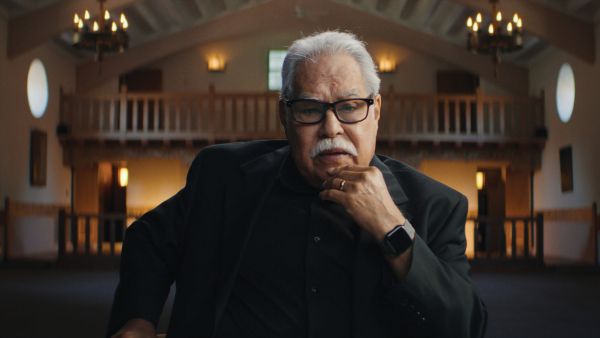
In the opening of this lively profile of pioneering Chicano writer and director Luis Valdez, actor/narrator Edward James Olmos intones, “There’s never been anyone like him. Ever!” As David Alvarado’s documentary unfolds, and we see his progression from migrant labor farms to creating a revolutionary theater group on the front lines of union politics, and finally to Hollywood box-office glory, we realize that Olmos’s impossibly grand statement may actually be true.
Valdez was one of 10 children born to Mexican immigrant farmworkers in 1940s California, and he began working on the labor farms when he was just six years old. He tells the story of landing a part in a school play, but just before he could perform his first role, his mother told him they had to leave town because the family was being evicted. He says that losing his theater role at that young age created a hole inside him that he strove to fill with his creative work for the rest of his life.
After college, as an English major, Valdez became involved in the grape workers’ strike in Delano, California, where he was born. Having grown up alongside those farmworkers, he knew firsthand how “intolerable,” in his words, their working and living conditions were. He wanted to contribute to the strike while utilizing his unique skills and interests, so he approached legendary labor organizer Cesar Chavez with a proposal to create a theater troupe for the striking workers. Chavez had little interest, telling Valdez there would be no budget and no time for rehearsals—essentially offering zero support—but he gave his permission nonetheless.
Thus, Valdez formed El Teatro Campesino, touring the migrant labor camps and using one-act plays to boost spirits and explore the themes of oppression and injustice that the workers were actively struggling against. One of the best parts here is the video clips of these performances and the audience’s reactions to them. (Though Chavez was highly esteemed at the time, “history would tell a different story down the line,” as the narrator refers to the revelations earlier this year regarding his private behavior.)
After winning a union contract for the grape pickers in 1967, Chavez’s focus shifted entirely to boycotting stores selling scab (non-union) grapes, and he no longer tolerated El Teatro Campesino—despite the vital role they played in lifting the striking workers’ spirits. As a result, Valdez and his team went independent, continuing their work in revolutionary theater and touring around California and the Southwest. His work caught the eye of the famous English theater director Peter Brook. This revealed to Valdez that his work could connect with the wider world, serving as the catalyst for his bigger ambitions and leading to the creation of the play Zoot Suit. Telling the story of the wrongful prosecution of Chicano youth during a 1940s Los Angeles murder case and the racial tensions that erupted into the Zoot Suit Riots, the play was a smash hit in Los Angeles.
The success of Zoot Suit had its limits, however, as the transition to Broadway did not work as well; New York critics savaged the play, forcing Valdez to regroup for his next project. He turned his attention to one of the first mainstream Chicano music stars, Ritchie Valens, whose hit song “La Bamba” remains a perennial American classic. We see the process Valdez went through to make the movie La Bamba, and how, even while directing a major Hollywood film, he faced discrimination from the crew. The movie ended up being a massive hit, grossing over $50 million in 1987, and it remains the most successful Latino film to this day, according to director Taylor Hackford.
One of the documentary’s strengths is its seamless integration of archival material. Footage from El Teatro Campesino, Zoot Suit, various protests, vintage interviews, and La Bamba is woven smoothly into the narrative, while the editing maintains a strong visual rhythm. It moves fluidly between performances, historical footage, photographs, and contemporary interviews, making the film dynamic and engaging throughout. The talking heads include Dolores Huerta, Edward James Olmos, Lou Diamond Phillips, Linda Ronstadt, and most of all, Valdez himself.
Valdez sums up his artistic-political philosophy by saying, “Go to the root, that’s where the juice is.” That is precisely what he has done throughout his career: creating plays at the root of the labor struggle, exploring the root of Chicano oppression and rebellion in the 1940s, and channeling the root of mainstream Chicano success through Ritchie Valens in the 1950s. By going back to the root, Valdez has been able to find a consistent current of Chicano resilience throughout American cultural and political history. A timely reminder of the power of art to dramatize history, American Pachuco: The Legend of Luis Valdez highlights how the past is not simply remembered—it is continually reimagined as a resource for struggle, identity, and collective possibility.








Leave A Comment