Richard Linklater’s Blue Moon is an exception to the rule that films limited mainly to one location can feel stagey and stifling. Lively yet deeply bittersweet, the biopic follows prolific lyricist Lorenz Hart (Ethan Hawke) drinking at Sardi’s on the opening night of Rodgers and Hammerstein’s Oklahoma! in March 1943, just months before Hart’s death. Richard Rodgers (Andrew Scott) began collaborating with Oscar Hammerstein (Simon Delaney) as a result of Hart’s deteriorating mental state and alcoholism.
It’s a painful night for Hart, dubbed “the saddest man I ever knew” by singer Mabel Mercer (one of the opening onscreen quotes). Hart arrives at the bar early, awaiting the Oklahoma! afterparty. Instead of wallowing quietly, he hides his sadness by deliriously chatting away with bartender friend Eddie (Bobby Cannavale), author E.B. White (Patrick Kennedy), and, during the party, 20-year-old Yale student Elizabeth Weiland (Margaret Qualley), by whom Hart has become complicatedly fascinated. In the background, a young man, Morty (Jonah Lees), plays standards on the piano, including some of Rodgers & Hart’s hits. (Hart, as if casting a character in his own show, nicknames the pianist “Knuckles.”) For Hart, it’s a critical night: Will he be able to continue to work with Rodgers on future projects, or will he be permanently replaced?
Erudite and highly opinionated, Hart is a great talker. He is contradictory in his feelings on the soon-to-be smash hit Oklahoma!, noting its occasional brilliance, while mostly seething over its homespun cheesiness and prophesizing (correctly) that it will play in high schools for decades to come. Throughout the night, Hart talks about his favorite and least favorite lyrics and lines from the show, as well as from the movie Casablanca.
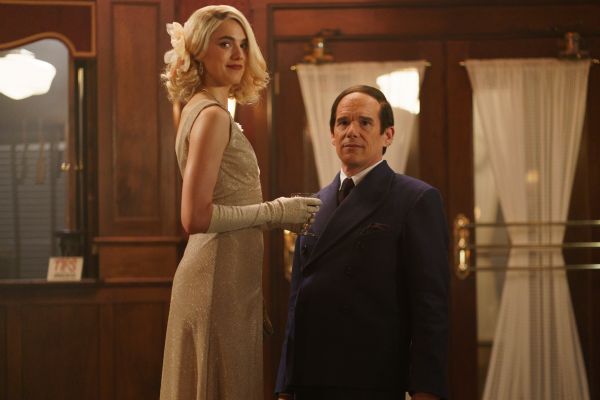
Novelist Robert Kaplow, whose previous and only other produced script was another Linklater showbiz-themed film, Me and Orson Welles, creates a tapestry of acidic banter with specificity and wit. In one of the more disquieting moments, Hart and Elizabeth are alone in the coat check room. Hart eggs Elizabeth on to describe in detail a hookup she had with a fellow male student. The scene is presented as if he’s aroused vicariously through her story. Although by some accounts Hart was discreetly queer in real life, here his queerness and innuendo are obvious to the people around him, especially Eddie. When a strapping lad, Troy (Giles Surridge), delivers flowers for Rodgers, Hart is flirty, inviting him to a party at his place (a party he likely won’t ever throw).
With a comb-over, cigar, and dark blue suit, Hawke plays this complex, multifaceted figure brilliantly. The camera angles—where characters loom much larger over Hart—effectively relay Hart’s stature and fading power. (He was barely five feet tall). It’s especially evident in a testy staircase scene between Hart and Rodgers. While basking in the glow of success, Rodgers also reveals sympathy for, disappointment in, and pity for Hart in a few brief moments. (Andrew Scott is quite good in his portrayal.)
Linklater’s movies are often referred to as “hang out films.” Blue Moon has a little bit of that quality: a drunken, cozy evening in a romantically-lit 1943 Sardi’s (re-created; the movie was shot in Dublin). The combination of the script’s layered dialogue and Hawke’s empathetic turn feels like an old Broadway standard: seductive and bitterly elegiac.



Leave A Comment