There are historical episodes and exemplary figures whose stories seem so obviously destined to become movies that it is a wonder why they have taken so long to be made. And yet, the timing isn’t always right. Sometimes certain stories have a manufactured, Hollywood feel because the industry conditions weren’t yet in place—lacking the right actors or the proper approach—to bring the best possible version to life. In that sense, Being Heumann would have been inspiring and relevant at any point in time. Only today could it become a landmark of representation, arriving at precisely the right moment. With a large ensemble of actors with disabilities filling the screen in major, supportive, and tangential roles, and with historically accurate intersectionality, this is an example of cinema representing and honoring history.
Following her Oscar-winning success with CODA, a story with and about deaf characters, Siân Heder returns with a more complex film, one that remains closely tied to her commitment to the real-life story while still being interested in crafting an emotionally effective narrative. Based on the autobiography of activist Judith Heumann, the result is more than a biopic exclusively focused on the individual struggles, tireless commitment, and admirable actions of a woman in a wheelchair who helped make reforms possible when no one else thought even the bare minimum was remotely achievable.
Instead, it confidently turns toward a detailed retelling of the 28-day occupation carried out in 1977 by a group of disabled activists led by Judy (Ruth Madeley) at the Department of Health offices in San Francisco, with the goal of pressuring Health Secretary Joseph A. Califano Jr. (Mark Ruffalo) into signing the legislation that would put Section 504 of the 1973 Rehabilitation Act into effect. (The takeover was also the subject of the Academy Award-nominated 2020 documentary Crip Camp.)
Until then, the law had existed merely as a legal ornament: the federal civil-rights protection that prevented any form of discrimination against disabled people in federally funded buildings, which would also entail possibly billions of dollars in expenses for ramps and other forms of improved accessibility. It’s easy to guess that this was the controversial part, and why no one had wanted to sign it until then.
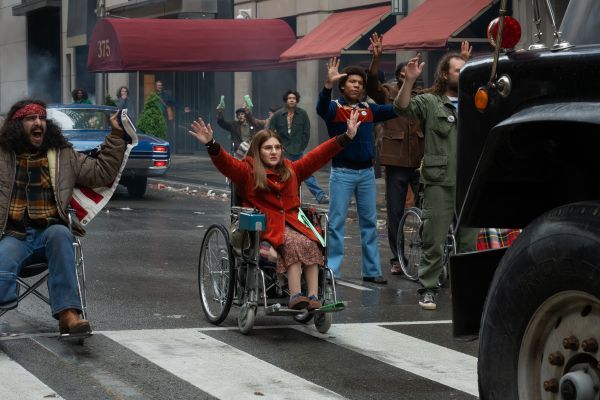
Although Judy exudes an inevitably heroic aura given the circumstances, the film doesn’t seek to create a hagiographic portrait. In one opening scene, she defiantly and stubbornly rolls her wheels at the head of a traffic jam caused and worsened by her own passage, before sticking her middle finger up at the truck driver blaring his horn at her. She’s proudly no Pollyanna, especially when compared with Kitty Cone (Madeline Delp), also a wheelchair user and another activist in the movement, who seems less inclined toward the confrontational approach championed by Heumann.
Over the course of the movie, we see just how alienating and exhausting Judy’s frequent lack of tact can be, as she remains so focused on the big picture that she fails to attend to the immediate worries of those she’s willing to represent and fight for. But it also depicts why honey isn’t always the answer when you’re not merely trying to catch flies, but fighting lions who refuse to be intimidated by a bunch of so-called “cripples.” Yes, Judy also embraces that uncomfortable word as a shield. Claiming herself as a cripple was another form of revolution, one that would ensure the voices of the disabled were heard.
The day-by-day account of the San Francisco occupation gives Heder the opportunity to create a collective portrait virtually unprecedented in its representation of disabilities performed by actors with disabilities themselves. This is perhaps one of the most admirable casting achievements of this or any other year, and Exhibit A for why a casting Oscar category was recently created. The drama puts on display the variety of struggles and ways of facing the world, but also highlights those with particular backgrounds and other defining characteristics, such as race, gender, and sexual identity.
At the same time, it emphasizes the advantages of coming together despite—and because of—those differences to claim a power that would be impossible without the unification of their efforts. When the authorities cut off the electricity and telephone lines in the occupied building, the activists manage to communicate with the outside world through sign language, relaying messages to other activists outside who can report what’s happening, without yielding to the pressure to abandon the building.
Of course, as compelling as this movie is as an ensemble piece, it cannot be overlooked that Madeley has taken on the role of a lifetime. Her furious and intense embodiment of Judy, with all her corresponding rough edges, makes it impossible to dismiss the whole enterprise as a worthy but glorified TV movie, even if you sometimes wish a stronger visual imprint could match the talent involved. Hers is a presence capable of filling the big screen with undeniable power, and one deserving of consideration among the best performances of the year.
Meanwhile, Being Heumann doesn’t fall into the trap of believing it represents the pinnacle of what can be done. Much like Heumann’s fights at the time, there’s a humility and a hopefulness in spotlighting the role of a crucial and necessary touchstone—one that could signal the beginning of greater things yet to come.



Leave A Comment