
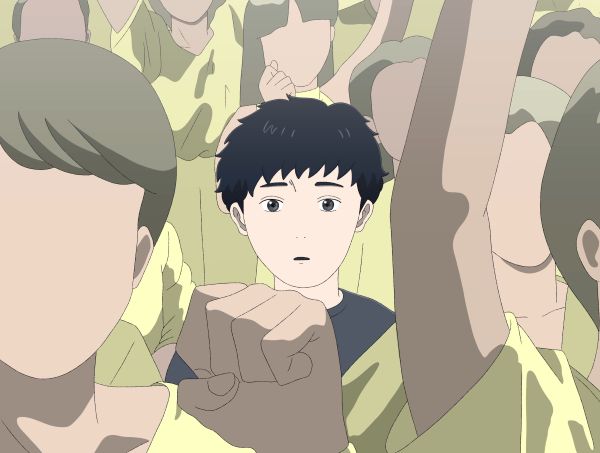
One beauty of telling a story through animation is the inherent lack of limitations. Animation can be grounded, but also deeply strange and fantastical, taking a character to unexpected places that you just can’t get on a live-action budget. Limitations are both noticeable and nonexistent in Jinsei, with writer-director Ryuya Suzuki animating the entire film in 18 months via crowdfunding in a flash-art-meets-comic-book style that covers one man’s life across an entire century. But it’s a film that jumps about so often that any unifying theme gets lost in the maelstrom.
Its protagonist (voiced by rapper Ace Cool) has many names, but not an official one. The last person to call him by his real name was his mother, the victim of a driving accident that seemingly stripped our lead of happiness for what comes next in life. His father remains hospitalized by the accident, with the boy’s stepdad coming to care for him. As a child, he’s Se-chan, attending classes at school while enduring the derogatory “Grim Reaper” moniker bestowed onto him by classmates. One exception is Kin (Taketo Tanaka), a new student who takes an interest in Se-chan and eventually reveals his desire to become a famous pop idol, despite being bullied for that dream at his last school.
Years later, Kin lands his idol audition, but the shady record CEO also recruits Se-chan to be part of this newly established boy band. The group is named ZENROKU, and Se-chan is renamed “Kuro,” followed by a montage detailing the routine these members face day in and day out to achieve international fame. The tradeoff? They are overworked and feel deeply empty inside, despite giving lively performances and smiles for the camera. Despite the mogul’s insistence that these young men are “birds in a cage” protected from outside threats by his benevolence, it’s clear that the opposite is true: The group is trapped in an abusive relationship, and their boss dictates their public images. But Kuro has always felt trapped, and not even fame and popularity can replace what he’s missing inside. That’s where Jinsei takes a turn for the strange.
Rather than fixate on his J-Pop days, the script keeps moving forward in time. We see Kuro as a jaded lover in a nightclub, then experiencing a late-stage career resurgence before the story goes full comic-book mode with a dystopian future involving underground bunkers and robots. In this exotically random timeline, Kuro’s enigmatic persona exists within the moment and reacts to how the world perceives him. The manner in which his story is executed, however, feels too random for Jinsei’s own good. Particularly in the third act, Suzuki jettisons anything realistic in favor of the aforementioned dystopian future and, in its final minutes, a quizzically open-ended sci-fi conclusion.
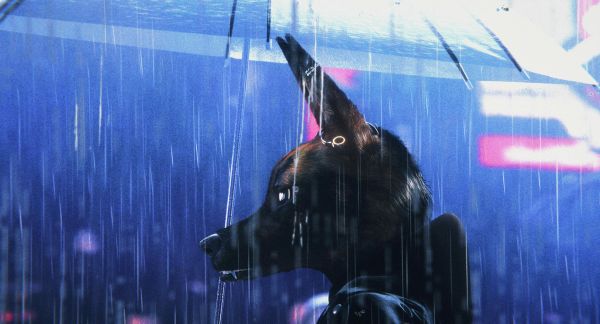
This world is a mesh of grays, blacks, and blues, highlighting the troubled socioeconomic problems of Kuro, fellow celebrities, fans, and even ordinary citizens who feel adrift. This color scheme highlights the double-edged sword nature of the movie as well, filling each scene with background detail. The forms are anime-inspired, yet the characters’ stiff poses are more reminiscent of photographs, with occasional movements animated like a cross between Flash and stop-motion animation. It’s ambitious for a limited budget, and when Suzuki leans into the power of those limitations (including two wordless montages in the opening and final act), there’s a certain charm to be found in his visual style. Sadly, though, the lack of a throughline between each time jump registers as incohesive.
Currently, animation is experiencing a unique renaissance where creators can put their stories out there without going through the usual studio channels. One need only look at Hazbin Hotel’s evolution from YouTube pilot to Prime Video series, or the ongoing success of Glitch Productions shows like The Amazing Digital Circus and Knights of Guinevere. Jinsei could easily be another strong chapter in this indie animation renaissance for some, but its scattered chapters can’t help but feel incomplete. It’s chaotic, and that’s certainly how life works, but I was hoping this story would connect on a deeper level that never fully arrives.




Leave A Comment