
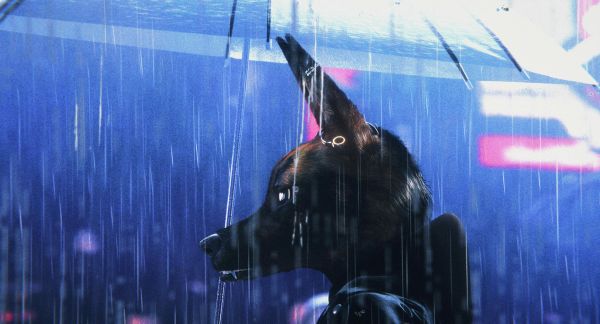
To review Bouchra, you have got to get a couple of items out of the way first: Orian Barki and Meriem Bennani’s animated feature showcases mostly female, mostly queer anthropomorphized animals. The lead beast is the titular Bouchra, a twenty-something Moroccan coyote with an underbite, a punky mohawk, and upright ears that recall the Egyptian deity Anubis. We follow Bouchra (voiced by Bennani) as she moves between noirish New York and her native, sun-blasted Casablanca, Morocco, her environments brought to life with a semi-3D animation style that telegraphs part puppet show, part graphic novel.
There is a lot of contrast and contradiction in this work: The vivid visuals are sometimes sleek, then herky-jerky close up. The narrative feels natural and real one minute, then art-damaged and capricious the next. But very likely, the off-the-wall creativity of this eclectic, polyglot work in Arabic, French, and English should persuade you to let objections go and just bop through Bouchra’s world.
Impressionistic, episodic scenes kick the movie off. Within her dark New York flat, Bouchra rebukes her mother via the phone for drawing a veil of silence over her lesbian inclinations—whatevs-style dialogue with maman and with Bouchra’s friends has an improvised teen-talk breathiness that feels both relatable and annoyingly banal at the same time. Bouchra gives in to a rendezvous with an overbearing ex named Nikki (Ariana Faye Allensworth), who happens to be a cow. (Animators must have had fun with the dimly lit, snappy interspecies sex scene that includes plenty of heat and sucking face). Meanwhile, the film hands Bouchra hipster props as a filmmaker, although she doesn’t seem to spend much time hustling in a contracting, competitive industry or, indeed, making movies much.
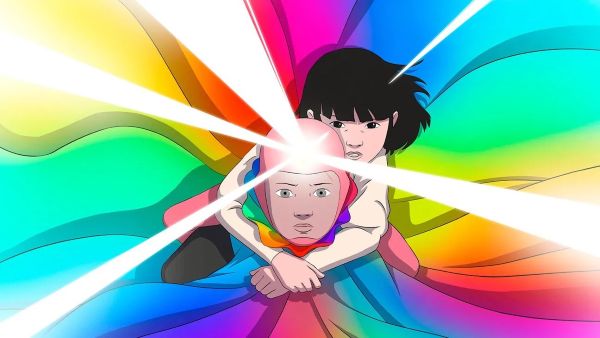
Events move back and forth in time and gain complexity as Bouchra heads back to Casablanca for a partial reckoning with her mother and also enjoys a fling with an older lawyer. Along the way, free jazz, kinetic Arabic music, and DJ sets unspool alongside wild flights of fancy, such as when a portion of Bouchra’s apartment elevator turns into a giant pair of lips and sings to Bouchra over trippy, blasted-out fields of exploding color. There is even a detour into a cloyingly sweet elementary school play. Some scenes, like a joyous shadow dance between Bouchra and her new lawyerly conquest, bracingly bring the focus onto attraction and a love of life.
Bouchra deals with family estrangement, queerness and the closet, and cultural prohibitions sometimes forthrightly, sometimes obliquely, and sometimes by not dealing with them at all. Yet you feel them at its center—they can just be hard to make out within Barki and Bennani’s peregrinations through pop music, odd set pieces, and wild visuals. Bouchra can feel flighty and improvised, but it may have something more serious to say about queer life between two cultures than a whimsical surface lets us see right away.
Leave A Comment