George Orwell’s 1945 novella Animal Farm, a high school assigned-reading staple for many decades afterward, is an anti-Stalinist satire and cautionary tale populated with animal characters to detail the ways a workers’ utopia devolves into an authoritarian dystopia through the machinations of corrupt, power-hungry leaders. It’s a potent, powerful message that’s been softened in various ways in its multiple cinematic adaptations to date, including a 1954 animated version secretly backed by the CIA and a 1999 live-action, animatronic feature produced by Jim Henson’s Creature Shop.
The latest iteration to be brought to the screen is an animated feature directed by actor-turned-filmmaker Andy Serkis, who also supplies a few of the voices. It’s a kid-friendly interpretation, written by Nicholas Stoller, that jettisons the book’s anti-Stalinism (which could be seen as a Cold War relic) in favor of lowbrow humor (with plenty of fart jokes) and a broad critique of extreme consumerism.
The broad plot outline of the original book remains more or less intact in this new version, which begins with a failing farm run by Farmer Jones (Serkis), many of whose animals are set to be taken to a slaughterhouse (at first misinterpreted by the animals as a “laughter house” due to a partially obscured sign). An animal uprising, led by the pig Snowball (Laverne Cox) and the boar Napoleon (Seth Rogen), saves the animals from this fate. After ousting Jones, the animals take over as owners of the farm and, as led by Snowball, institute a set of new rules, including prohibitions against living in the farmhouse, killing other animals, and drinking alcohol (euphemistically termed “naughty juice”). The most important rule is that all animals are equal.
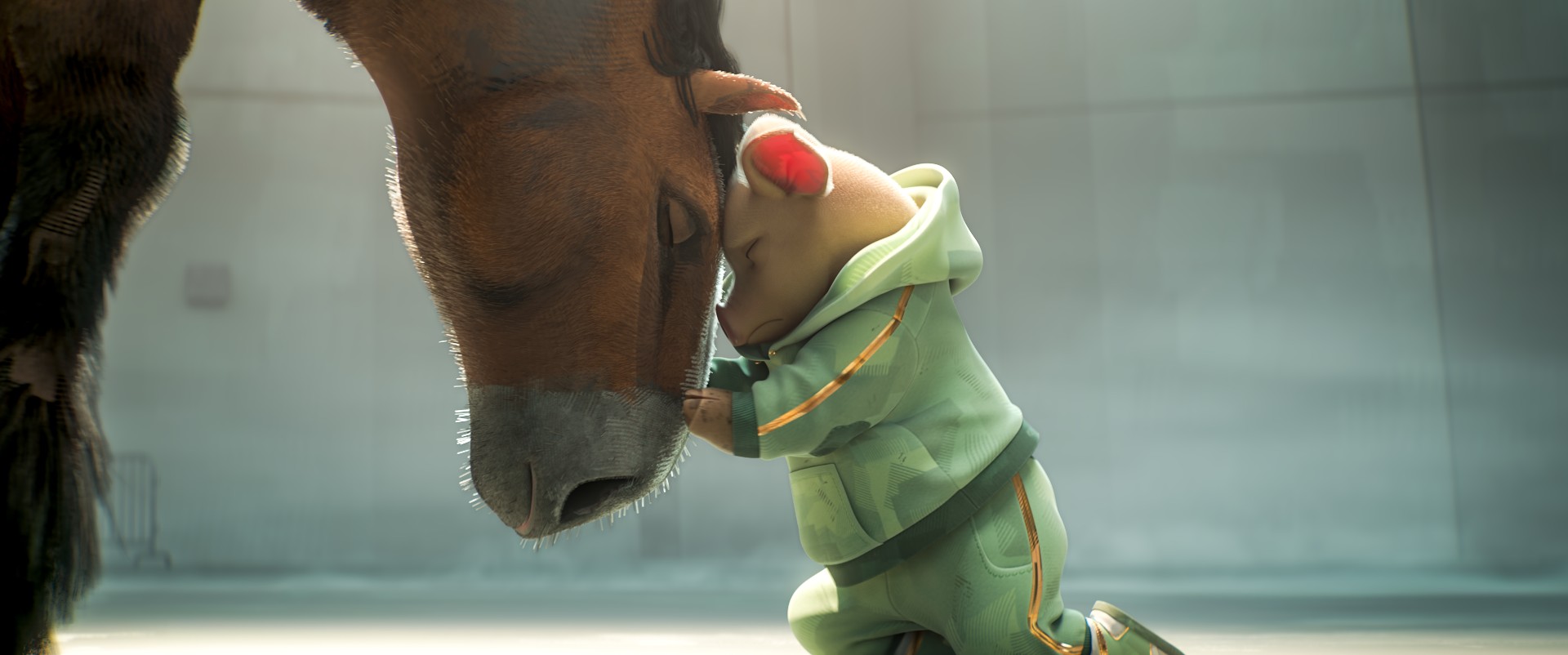
That last rule doesn’t sit well with Napoleon, whose outsize ambitions, lust for power, and manipulations of the other animals cause the ouster and exile of Snowball, leaving Napoleon as the sole boss. However, as voiced by Rogen, Napoleon comes across as somewhat less villainous than in Orwell’s original novella and more like a silly, corruptible character. This film’s actual villain is Freida Pilkington (Glenn Close), a tech billionaire scheming to take over the farm, manipulating Napoleon and exploiting his greed and consumerist attitudes, luring him with fancy cars and tech gadgets.
Animal Farm is a long-gestating passion project for Serkis, who spent a reported 15 years bringing this adaptation to fruition. With that in mind, it’s disappointing that the result feels so bland and compromised. It does boast an impressive voice cast that also includes Woody Harrelson, Kathleen Turner, Kieran Culkin, and Gaten Matarazzo (as Lucky the piglet, a character not in the book). The animation is smooth but visually uninspired CGI that comes across as a pale imitation of bigger-budgeted Hollywood spectacles. Most egregiously, it betrays the spirit of its source material by grafting a happy ending onto Orwell’s original conclusion, which portrayed the pig rulers as indistinguishable from the previous evil humans. Orwell’s novella is an enduring literary classic; Serkis’ film is a much more disposable product, likely to be soon forgotten.
Leave A Comment