
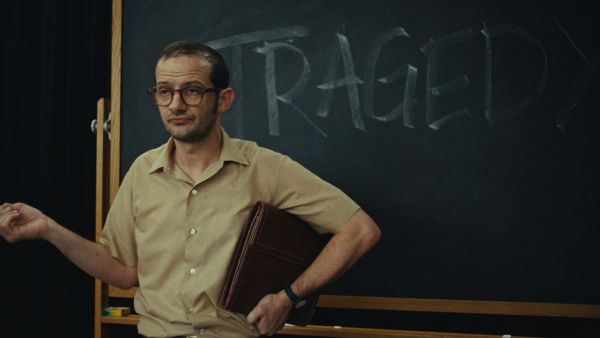
Giselle Bonilla’s directorial debut feature is a patchy effort, filled with jokes that don’t land and only occasional bright spots. Doug Leibowitz (Will Brill) is a Southern California middle school theater teacher and stuck-in-the-mud playwright recently jilted by co-worker and fellow teacher Abigail (Gillian Jacobs), who is now dating the principal with an in-joke name, Michael Brady (Rob Lowe). Doug describes Principal Brady as a “boiled cabbage of a person” (one of the few funny lines). In hopes of taking down his foe, Doug begins staging a musical sure to be controversial.
Doug is, admittedly, a difficult and one-note character to connect with. One’s tolerance of the film may be tested by a protagonist who is, at every turn, annoyed with “wokeness.” When filling out an application for a playwright fellowship, he’s visibly upset that he’s not part of a marginalized group. He’s also relentlessly agitated and self-absorbed.
Lowe’s Principal Brady, in a blue button-down tucked into jeans, with a helmet of hair and raspy voice, seems to be mimicking California Governor Gavin Newsom. Brady, a harmless fluff of a well-meaning White male liberal, has an obsession with getting his school added to the Blue Ribbon honor list. Though Principal Brady is established as the obvious villain in the piece, I found myself preferring his brief company of lackadaisical doltishness over Doug’s dogged malaise.
Sometimes a film with a little style, or a compelling lead performance (or compelling performances around it), can make the antics of a complicated antihero alluring. The Musical lacks these qualities. It has a flat look, and Brill’s overwrought gestures and strained speech never feel authentic.
Doug’s cinematic templates are Matthew Broderick’s high school teacher Jim McAllister from Election and Robert De Niro’s Travis Bickle from Taxi Driver. These are two very different and far superior movies that The Musical often riffs on. Doug wears a teacher costume reminiscent of McAllister’s, and the two movies also have similarly styled codas that hint at new beginnings.
The Musical is at its best when Mateo Nossa’s lively score takes on a macabre, grandiose Pino Donaggio or Bernard Herrmann–esque Taxi Driver lavishness. I wondered if the film had maintained this sinister tone, paired with Doug’s voice-over, maybe it would have been tenser, more involving.
It’s also not surprising that Abigail avoids Doug. I longed for her side of the story: The two recent choices she’s made in men—Doug and Principal Brady—are quite sad. Jacobs plays the character with as many shades as she can, but the movie is so chained to Doug’s perspective that the writing for Abigail remains thin, as do the middle schoolers, as charming as they sometimes are.
Bonilla shows promise as a director, especially when idiosyncratically engaging with other films. (The Manchurian Candidate is a very funny choice for Doug to make the middle schoolers watch, while railing against “the system.”) Yet there are some baffling decisions overall. At one point, Doug makes the class chant that “The superpower of theater is the element of surprise!” It’s too bad the film gives away the joke of its climactic musical early; otherwise, it may have really been more acidic and rewarding.









Leave A Comment