
Are the kids all right? Or perhaps the more relevant question is: Are they too all right—too protected for their own good? That central concern seems to have inspired I Want Your Sex, Gregg Araki’s new film. It marks a timely comeback for the agent provocateur, commonly heralded as one of the defining voices—or perhaps, more accurately, gazes—of the New Queer Cinema movement, after 12 years away from challenging audiences on the big screen. During that time, in which his work has been devoted exclusively to television, the American director appears to have reflected on the relationship between today’s youth and their sexuality, as well as the vital role sex can still play in mainstream movies. To explore those ideas, he centers on an ordinary American man in his early 20s who finds himself entangled in an unequal relationship of power and sexual domination with his highly experienced boss, a woman in her late 30s.
In Los Angeles, Elliot (Cooper Hoffman) lands the opportunity of a lifetime when he is hired as an assistant at the studio of Erika Tracy (Olivia Wilde), a famous and iconic contemporary artist whose work has long centered on humanity’s relationship with sex and sexuality. Apple (Chase Sui Wonders), Elliot’s best friend and roommate, asks what exactly separates Erika’s work from pornography. Elliot is far less prone to prejudice or sexual aversion, confidently answering: “Lighting, context.”
Elliot is still very much a creature of his generation when it comes to approaching relationships with the opposite sex—carefully and cautiously. His relationship with his girlfriend, Minerva (Charli XCX), depends entirely on what she decides and consents to at any given moment, which usually means little to no sex. But his sexual dry spell is about to come to an end, for better and for worse, when Erika summons him to her office and begins asking questions about his private life. She confides, with the utmost casualness, that things probably will not become awkward between them if they start having sex. Despite his astonishment, Elliot agrees to the arrangement, which immediately establishes the nature of their mostly sexual relationship through her proposition that puts everything into perspective: “Don’t walk. I really prefer if you crawled.”
I Want Your Sex is not specifically about workplace sexual abuse, but rather a deconstruction of the conventions of the erotic thriller, presented as a sex comedy fully aware of the raised eyebrows and nervous laughter it may provoke from audiences conditioned against messy, shameless, morally ambiguous, and proudly problematic sexual politics. In fact, it does not begin canonically with seduction, but with the aftermath: An unconscious Elliot, dressed in women’s underwear, staggers toward a swimming pool where he discovers Erika’s corpse (?). The narrative then jumps 9½ weeks earlier (sure you get the reference) as Elliot recounts his testimony to the police, explaining both what happened and his relationship with his boss.
However, not for a single second—except perhaps during those opening Sunset Boulevard–esque images (albeit with kink)—does Araki bother pretending that we are watching a dangerous cautionary tale. In stripping away the aura of crime and taboo that the premise could so easily have embraced, the movie finds its own form of edge, one adapted to what remains scandalous today: the notion that sex can simply be sex, with all its experiments and fetishes freely entered into by consenting adults.
True to its title—and to everything one expects from Araki—the result is anything but shy, with Hoffman and Wilde sharing effortless chemistry completely free of inhibition. It requires neither full nudity nor explicit sex scenes to playfully convey what unfolds behind closed doors between boss and employee in a dominant-submissive relationship, making us feel like voyeurs peering through a window. For example, the image of Erika holding a lubricant-covered dildo, alongside Elliot’s expression as he experiences being penetrated for the first time, reminds us that there is still an important distinction between art and pornography. Yes, lighting and context, but also compelling storytelling, emotional stakes, and a genuine artistic point of view.
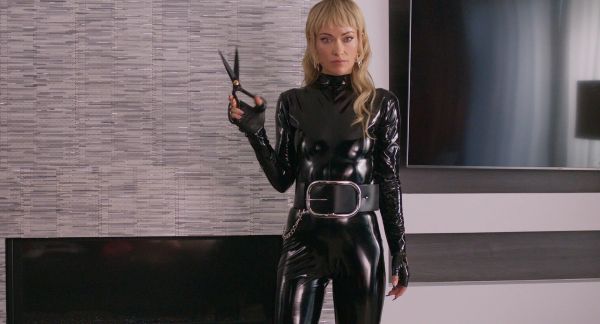
Wilde, for her part, deserves special mention thanks to her mesmerizing presence and utterly committed performance, creating a kind of sexy monster who may well become one of the most memorable original characters you see this year. It also helps that the succession of costumes she wears throughout is consistently striking and extravagant. In a way, the production design and cinematography possess a pop-kitsch quality, resembling a contemporary museum installation in their own right—one that celebrates art’s anything-goes devotion while simultaneously observing it from a skeptical critical distance.
Although the thematic concerns are frequently verbalized by its characters—particularly Erika, who functions as a kind of prophet preaching sexuality as the path toward liberation and emancipation from morality and hypocrisy—Araki never loses sight of the unequal power dynamic between his protagonists. Elliot’s inexperience becomes territory for Erika to exploit and manipulate at will, all in the name of supposedly necessary growth and rewarding pleasure. The dark comedy’s climax unfolds with appropriate sensitivity, without sacrificing its spicy humor or its lucid defense of the idea that some experiences are indeed necessary for us to grow. I Want Your Sex is Araki’s plea for us not to fear our desires—and, above all, not to become so cautious that we avoid making mistakes or allowing certain excesses to corrupt us just a little more than they should. There is value in recognizing that we are old enough to take chances, even if all that remains are exhilarating memories and the occasional nightmare.







Leave A Comment