A “stoner film,” as a particular comedy subgenre, always sounds like far too much fun on the page, but how many times has it actually succeeded in execution? Pineapple Express is perhaps the holy grail in its purest form, while movies like Dazed and Confused, The Big Lebowski, or Kevin Smith’s early films (Clerks, Mallrats) are hybrids flirting with the category. And how often has this kind of movie endured without feeling almost immediately dated? Let’s just say there are many Cheech & Chong comedies nearly unwatchable today. In any case, if anything is proven by the new and rare female-led stoner movie The Wrong Girls, it is that there is always a new generation of marijuana enthusiasts willing to try to earn our laughter and complicity at the expense of their addiction.
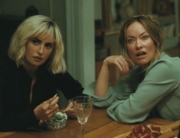
Written and directed by Dylan Meyer in her feature-length debut, The Wrong Girls starts from the premise of a traditional combination of buddy movie and stoner comedy, only this time starring two women—which, even in 2026, is still almost entirely novel. (Gregg Araki’s Smiley Face, 20 years ago, for example, couldn’t be bothered to give its stoner female protagonist a substantial friendship with another woman.) Can two women who are best friends and marijuana lovers be just as irredeemably idiotic as the male counterparts who have dominated this type of story forever? Sure, the unsubtly named Frankie (Kristen Stewart) and Molly (Alia Shawkat) have clearly been conceived to level the playing field.
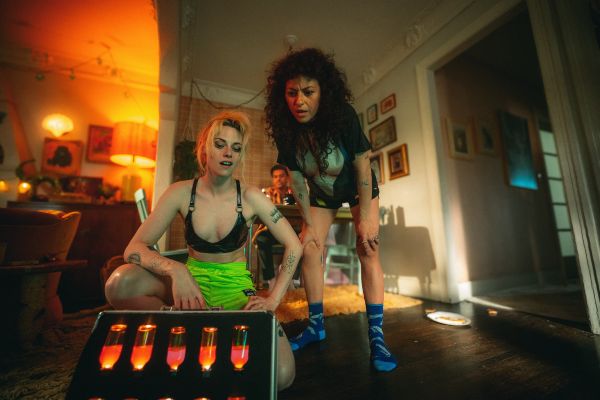
These two women in their thirties are also roommates who share rent responsibilities and their stacks of weed, with no steady jobs and always ready to spend an entire night watching documentaries about marine animals while inhaling from the Bong-A-Tron Frankie has created. (She is a former engineering student who dropped out of Stanford.) Meanwhile, the months of rent due in less than two days might be less of a problem tha it seems if Molly can complete a spreadsheet for her data-entry freelance job that appears to be important and valuable enough for a client to pay thousands for it. (Real-world logic and economics are not a concern in this movie.) So, of course, these women are also secretly smart and talented, but stoner idiots can still have brilliant minds and serious addictions at the end of the day.
Frankie and Molly share countless memories and anecdotes, as well as two cats, and there is nothing they don’t know about each other. But in case the strong chemistry between Stewart and Shawkat might confuse you, they are strictly heterosexual, and the screenplay constantly reminds us that they are romantically or sexually involved with men with whom we perceive not even half the electrifying spark that exists whenever they are together. Is this a secret joke in itself, or a fundamental blind spot on the part of its storyteller? The latter becomes clearer. Representation is certainly advancing at a snail’s pace, because apparently it would be asking too much for a female-led stoner film to also allow its women to be queer.
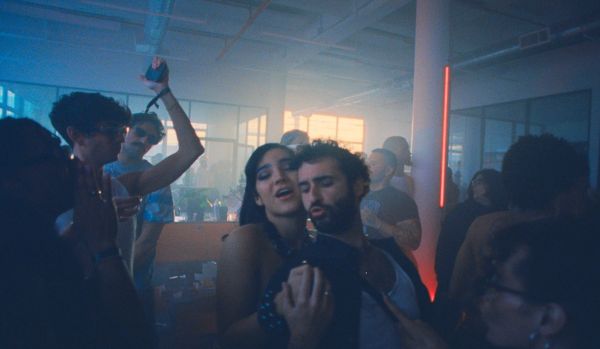
Nevertheless, these relationships with the men in their lives help move the plot forward and create the conflicts necessary to test their friendship. When Frankie attends a party, she runs into her ex-boyfriend and his new girlfriend, Frances, who looks exactly like her (Stewart also plays her). There she also meets Dave (LaKeith Stanfield), a mysterious metalhead with whom she flirts, hoping for a rebound while drunk, but he turns out not to be what he seems. Dave, in turn, believes he is dealing with Frances, and the case of mistaken identity leads to the delivery of a piece of luggage that should never have ended up in Frankie’s hands in the first place. Inside are several jars containing a kind of experimental drug processed from squid urine. The following morning, without remembering much of what happened, Frankie and Molly recklessly decide to try it.
The drug’s effects on the women are unlike anything they have experienced before, resulting in a psychedelic trip that lasts for hours but leaves behind long-term effects they gradually begin to discover, including telepathic abilities that allow them to read each other’s minds, as well as their cats, who have also ingested some of the drug. (The pets are voiced by Seth Rogen and Kumail Nanjiani.) On top of this, a group of Danish henchmen are after them, intent on recovering the suitcase and putting their lives in danger. By the time they realize the trouble they have gotten themselves into, it may be too late to recover whatever semblance of normality their lives once had.
Sounding better in description than in execution, Meyer’s vision unfolds as an endless parade of jokes and absurd situations, making room for telekinetic powers, party crashes, endless chases, and thankless brief appearances by Kate McKinnon (awfully restrained) and Geena Davis (probably a totemic presence meant to remind us—as a disservice to the present movie—of Thelma & Louise, the better film about women on the run in which she once starred). Once all the pieces are in place, it does not take long for the movie to become repetitive, predictable, and incapable of inspiring much more than a few giggles here and there. The Wrong Girls seems to exist simply to check off the list a movie that has not yet been made, only to remind us of others that have—and that did it much better—while wasting to the fullest the talent surrounding it. It certainly looks and sounds like a brilliant idea, but only to someone under the influence.
Leave A Comment