
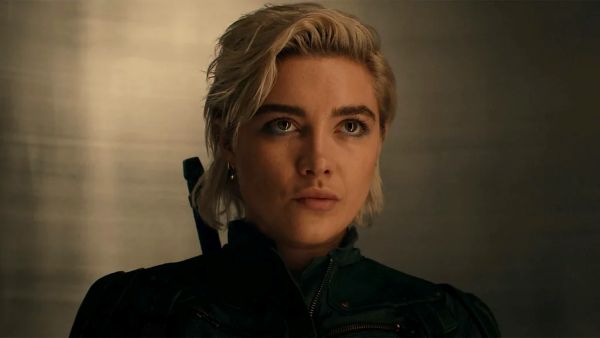
Marvel loves nothing more than a good team-up. In an era where the Marvel Cinematic Universe’s live-action hero and anti-hero roster has grown to Galactus-sized proportions, there are plenty of crossovers to be had—even if, despite some solid releases, audiences continue to question the franchise’s long-term direction. Thunderbolts* at first glance, seems to fit the usual mold: bringing together a group of C-listers from past movies and streaming shows to fight for a common cause and prove themselves as heroes.
That would be the normal Marvel approach. But Thunderbolts* goes against the grain of its own IP expectations, rejecting the usual bombastic set pieces and grandiose scale in favor of something more serious and intimate. It might not be the best entry in Marvel’s Phase 5 lineup, but as the final chapter in this stage of the franchise, Thunderbolts* shines as easily the most personal since Guardians of the Galaxy Vol. 3.
All superheroes undergo pain—that comes with the territory of origin stories and daily battles against supervillains. However, this movie’s cast suffers less from physical pain than from a lack of purpose and deep-seated depression. Former assassin Yelena Belova (Florence Pugh) admits as much in the opening scene, fearing there’s a “void” in her that hasn’t closed since learning about the death of Natasha Romanoff, a.k.a. Black Widow. She still functions—expertly parachuting off a skyscraper and neutralizing guards inside—but it’s clear she’s running on autopilot. She’s buried herself in work, has few connections beyond her estranged surrogate father and ex-Soviet super soldier Red Guardian/Alexei Shostakov (David Harbour), and desperately needs more than just missions from handler Valentina Allegra de Fontaine to stay afloat.
Not that Valentina (Julia Louis-Dreyfus) doesn’t have problems of her own. The shady CIA head is dealing with an impeachment hearing in Washington, covering her tracks so no black-ops experiments trace back to her. To tie up loose ends, she sends Yelena to an abandoned warehouse so she can eliminate a target on her behalf. The only catch? Other antihero operatives, including U.S. Agent (Wyatt Russell), Ghost (Hannah John-Kamen), and Taskmaster (Olga Kurylenko), have also been dispatched there, presumably to kill each other. Instead, they team up and try to escape—when they’re not bickering. Joining them is Bob (Lewis Pullman), an amnesiac test subject whose loopy demeanor masks an unlimited, and rather terrifying, level of power.
It takes a while for Thunderbolts* to show its cards. The first 15–20 minutes are unusually slow, reestablishing Marvel’s bureaucratic side—including Bucky Barnes’s (Sebastian Stan) turn as a U.S. congressman—and some characters are underused. (Taskmaster is little more than a cameo, and Wendell Pierce feels overqualified as Bucky’s political colleague.) But once the team escapes, the pacing sharpens. Unlike other Marvel entries, Thunderbolts* doesn’t lean heavily on rapid-fire quips—though the laughs that land do so effectively. Instead, the film turns psychological, devoting long stretches to conversations and character interplay that prove more compelling than any standard brawl.
Not that Thunderbolts* lacks fight scenes. They’re here, and director Jake Schreier (Paper Towns, Beef) keeps them energetic, if intentionally low-key. But the passive-aggressive squabbling is more engaging, offering deeper insight into why these characters are stuck in emotional ruts. There are nods to other Marvel properties—the aftermath of Captain America: Brave New World is referenced—even as the film avoids diving into the larger multiverse chaos.
Each character suffers from a profound sense of alienation, and uniting to take down Valentina—however modest the scale—gives them a glimmer of purpose and camaraderie. In that sense, it’s fitting that Bucky, the film’s weary veteran, serves as the group’s de facto recruiter, given his own history as a brainwashed assassin. And Bob’s fractured psyche—amplified by Valentina’s government experimentation—embodies the struggle of living with unpredictable highs and lows. Even for super-soldiers, emotional inadequacy isn’t something you can punch or shoot away.
Thunderbolts* can’t address every character’s trauma as thoroughly as the “Guardians” films, but it treats them as human beings—especially through Yelena and Alexei’s tragicomic bond. They’re not the heroes you’d expect to root for, but by the end, you can’t help it. And it’s refreshing to see Marvel embrace a more indie tone—as hinted by its unconventional final act and a trailer styled like an A24 film—before The Fantastic Four: First Steps and Avengers: Doomsday inevitably return the IP to Hollywood spectacle once more.
Leave A Comment