
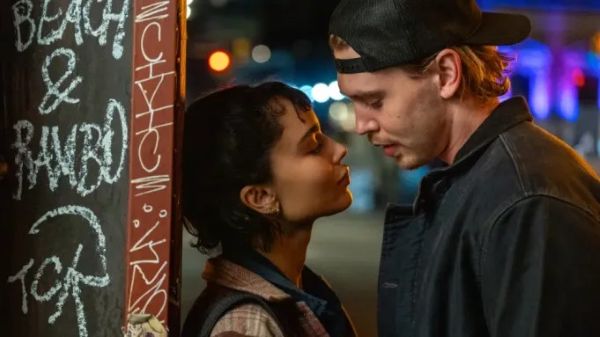
If you’ve seen enough films from Darren Aronofsky, you might have sworn the director would never be capable of loosening up his usual intensity or, it must be said, his sometimes overbearing pretension. Well, I’ve got some news for you. Aronofsky’s new film bursts into theaters with electrifying energy, a perfect action romp to close out summer escapism and kick off the more sober and ambitious fall movie season.
Based on Charlie Huston’s novel of the same name and adapted by the author himself, Caught Stealing initially looks like a straightforward studio assignment that could have been handled by anyone. Aronofsky gradually makes it his own, however, without losing sight of delivering an extremely enjoyable film. Set in Giuliani’s New York of 1998—a time of transition between the city purging crime and the gentrification that would eventually tame it—the moderately normal life of Henry “Hank” Thompson (Austin Butler) is about to be completely upended. A former baseball star-in-the-making from California, Hank is a small-town kid living in the big city, spending his days as a bartender, keeping track of his beloved Giants, and drowning frustrations in alcohol and well-sustained smiles. A scar on his leg and the recurring nightmare he wakes up to every morning are constant reminders of the car accident that ended his dream and also cost the life of his childhood best friend.
Unlike so many other Aronofsky protagonists, Hank tries to stay afloat without losing his sanity, even though there are signs he’s becoming an alcoholic. His relationship with paramedic Yvonne (Zoë Kravitz) is in that blissful stage in which sexual chemistry is addictive and growing affection is mutual, without complications. Yvonne offers him a half-serious, half-joking diagnosis that ends up sounding ominous: “You always act purposely stupid when shit is about to get real.” Later, Hank’s British neighbor asks him the small favor of cat-sitting while he flies to London to visit a sick father. With his towering Mohawk, punk wardrobe, and insult-ready chatter, Russ (Matt Smith) is also a petty criminal. Not long after, shady visitors looking for the absent neighbor stumble upon Hank, drawing him into threats and confrontations. They are unwilling to take “I don’t know” for an answer.
The first 20 minutes are a misdirection. We stroll through a version of New York that barely exists nowadays, with a gaze that mixes criticism and nostalgia (Aronofsky was born and raised in Brooklyn), and witness the romantic exuberance of Hank and Yvonne in and out of bed. It’s a brief distraction in a film by a director perennially obsessed with the interplay of physical violence and cruelty. When Russian thugs interrogating Hank about lost money escalate matters into a beating that leaves our naïve protagonist sprawled on the floor, with blood and urine pooling around him, you’re quickly reminded who’s behind the camera. If you’re still not convinced, the next scene seals it: Hank wakes up two days later in a hospital, discovering stitches in the side where his kidney has been removed. The back-and-forth between what feels like Aronofsky’s most relaxed, accessible effort and his trademark shock tactics creates a vital tension, one that mirrors the portrait of a New York that once was both unlawful and lethal, as well as charismatic and seductive.
Thus begins Hank’s odyssey across New York’s boroughs, searching for answers about supposedly stolen money greedily hunted by dangerous factions. Besides the Russians (Nikita Kukushkin, Yuri Kolokolnikov), there are a pair of Orthodox Jewish brothers (Liev Schreiber, Vincent D’Onofrio), who are much more violent and threatening, and a Puerto Rican henchman (Benito Martinez Ocasio, the worldwide music superstar Bad Bunny), who barks more than he actually bites. Plus, police officer Roman (Regina King) is on the case, possibly bringing Hank more trouble than help. Add in Griffin Dunne as a biker who happens to be Hank’s bar boss, and it’s clear Aronofsky knows he’s making his After Hours. The Scorsese film was once thought of as a minor work, but its reputation has steadily grown over the years. It’s a similar case of a singular filmmaker working with humbler material.
Caught Stealing combines an absurd, gripping tone with tragic, devastating moments. In a way, it’s a throwback to the crime capers commonly released in the very era it’s set. Only, this is exactly the type of film the director’s peers were making while he was forging his cinematic descents into hell. Rather than just an homage to ’90s crime and action cinema in the style of Ritchie, Tarantino, or Boyle, it feels like a lost and rediscovered entry from an alternate timeline—one where Aronofsky started his career making films like this instead of Requiem for a Dream (2000).
Meanwhile, despite the colorful parade of characters, Butler never lets anyone steal the movie. The American actor confirms he’s one of the most attractive screen presences of the moment. This leading performance cements what we saw in Elvis and what he’s consistently delivered even in smaller roles since: We’re looking at an undeniable movie star, arguably the most rawly carnal, directly sexy actor of his generation, when compared to contemporaries like Chalamet, Mescal, or Elordi.
Caught Stealing showcases a filmmaker who may not change his stripes but can still surprise us just when we thought we had him figured out. Get ready for an enjoyable and thrilling ride from start to finish. Just don’t let your guard down: This is still an Aronofsky trap, after all, and not even the cat might make it out unscathed.




Leave A Comment