
The “John Wick” films are at their strongest when they embrace simplicity. There’s an easy-to-grasp, almost playground logic to this action movie universe (man avenges dog, no killing on Continental Hotel grounds) that’s helped it become one of the most beloved action franchises of the last decade and spawn countless imitators. Stick to the formula, and you get the highs of John Wick: Chapter 4. Overcomplicate things, and you end up with something as frustrating as The Continental TV series.
Sandwiched between those two extremes is From the World of John Wick: Ballerina, or Ballerina for short. This interquel, set between the events of Chapter 3—Parabellum and Chapter 4, makes Keanu Reeves’s Wick a secondary player in a new character’s odyssey of bloodshed and revenge. Her trial by gunfire proudly continues the franchise’s legacy of thrilling, unique action scenes—even if its attempt to tell as enthralling a story as the original John Wick falls a bit short. Ballerina even marks a clever full-circle moment for star Ana de Armas, who made her English-language debut opposite Reeves in 2015’s Knock Knock, and now stands toe-to-toe with him as an action star just as worthy of admiration.
In Parabellum, fans were briefly introduced to the Ruska Roma, a crime syndicate that raised Wick as a child and trains new acolytes through a combination of dance and assassin skills. One such member is Eve Macarro (de Armas), who, as a young girl, watched her father die at the hands of mysterious killers. He put up a valiant fight against the assassins and their leader, the Chancellor (Gabriel Byrne), but eventually succumbed to his wounds, leaving Eve orphaned. Narrative breadcrumbs suggest that she has a natural-born instinct for killing—which, combined with a visit from Continental owner Winston (Ian McShane), finds Eve a new home with the Ruska Roma’s leader, the Director (Anjelica Huston). This gives her a place to train, but what she truly desires is revenge, even after a chance encounter with Wick sees him imparting some crucial wisdom: The door’s still open to leave.
Little by little, Eve builds herself up as a formidable fighter who, in due course, crosses paths with her father’s killers, a cult whose history with her adoptive home is built on an uneasy truce. But being a “John Wick” story, our hero’s relationship to the rules is tenuous at best. So, Eve sets out to finally get vengeance with help from Winston and Charon (Lance Reddick, in his final role), even as the violence reunites this hunter with unexpected faces from her past.
While it’s always fun to reenter John Wick’s world, Ballerina’s lore additions aren’t as compelling as they aim to be. What begins as a simple revenge story evolves into a training montage, then opens up half-solved mysteries about the cult’s isolationist policies after Eve meets exile Daniel Pine (Norman Reedus) and his daughter, who are on the run from the Chancellor’s foot soldiers. Ballerina works more because of de Armas’s performance than from anything we learn about Eve’s journey—especially when the story throws in a major twist that aims for emotional resonance but doesn’t quite earn it. More successful details—like the final act set in Europe—lean into the Wick universe’s inner absurdity, including an entire village where every man and woman, parents included, somehow knows how to shoot and perform gun-fu on outsiders.
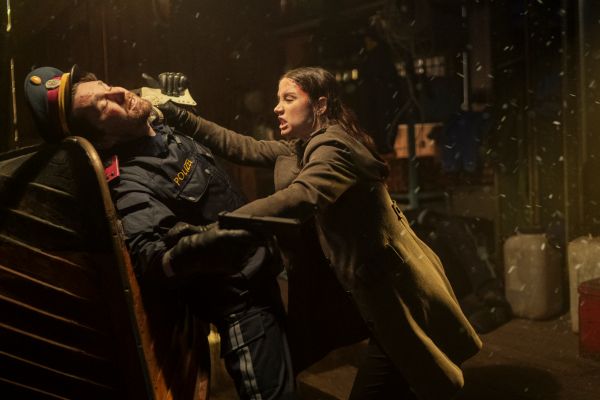
If you go to a “Wick” film, you’re going for the action. Under the eye of Underworld director Len Wiseman, Ballerina delivers it with energetic glee: well-choreographed, stylized fights with creative, video gamey spins. Sometimes they involve guns, or grenades, or a gun and kitchen blade taped together. Or even more outlandish weapons like ice skates and flamethrower duels—de Armas handles them all with aplomb. Having shown her action chops in No Time to Die (and, to a lesser-acclaimed extent, Ghosted and The Gray Man), this feels like the culmination of her career so far, with proper lead-character energy. There’s also a clear indicator that she’s not Wick: Eve’s fights routinely involve her getting thrown around, bludgeoned, and bruised before landing successful takedowns, including in a brief fight against Wick himself. While the story doesn’t fully rise to match them, the fights absolutely live up to the franchise’s reputation.
Eve’s story isn’t as intriguing as the shootouts and beatdowns she delivers. Nevertheless, Ballerina thankfully never leans too hard on existing “Wick” cameos as a crutch. Nor does the film shy away from its influences. This has always been an IP indebted to the Hollywood performers of old—a vibe literalized when Eve beats up an assassin with a remote control, causing the TV to flip through clips of the Three Stooges and Buster Keaton. Different dance moves, same flow and spirit as mainline John Wick. Simple, but fun as hell when it works.

Leave A Comment