
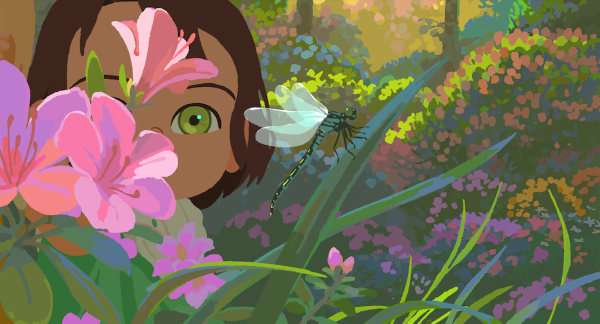
Life is full of core memories that, from an early age, awaken us to the world. When those memories manifest, let alone begin, varies from person to person, but they’re often the first thing we remember. With the pint-sized animated protagonist, Amélie (voiced by Loïse Charpentier), it takes a while for such a moment to arrive—so much so that, in the beginning, she is closed off from her family and views herself as God in a human body.
Co-directed by French filmmakers Maïlys Vallade and Liane-Cho Han, this gentle coming-of-age story and adaptation of Amélie Nothomb’s 2000 novel The Character of Rain visits the earliest years of a child’s life and how such a small period of time can leave a momentous impact on how she sees herself, particularly in relation to culture. The youngest child in a family of five, Amélie is Belgian but born in Japan, thus making her Japanese home the only one she’s ever known. She perceives herself as someone who’s seen a lot (hence the initial comparisons to God), but for more than her first two years, she rarely interacted with her parents, brother, or sister. Then, in 1969, an earthquake triggers something within her—something that compels Amélie to take her first steps and speak her first words, albeit with the horror of learning others don’t see her as God.
This awakening continues after Amélie’s grandmother (Cathy Cerda) comes to visit, unlocking her curiosity through a small but significant bite of white chocolate. Upon tasting it, she now wants to run, speak full sentences, and demand more answers to questions after receiving unsatisfactory answers. With her grandmother arrives an even more important figure: a young housekeeper named Nishio-san (Victoria Grosbois), who encourages Amélie’s curiosity. Despite not being part of the family, Amélie views Nishio-san as an older sibling.
Conversations bring to mind old Calvin and Hobbes comics, juxtaposing childhood innocence with weighty adult subject matter. Amélie is not one to feign naivety regarding death or pain, yet treats gentler mysteries (such as why carp fish symbolize boys) with unwavering inquisitiveness. Animated with a bold, lightly-stylized pastel color palate, her world is both semi-realistic and fantasy-like, envisioning these childlike discoveries as acts of wonder. When Amélie witnesses her first springtime, she doesn’t just smell the flowers. She runs through gardens at top speed, causing each flower in her path to bloom and burst into a menagerie of natural beauty, demonstrating just how wondrous this world looks from the ground up.
Those colors balance out the dark specter of World War II, which hangs over this film at key interludes. As a wartime survivor, Nishio-san sees Amélie as a stand-in for her lost family, deviating from the house’s embittered landlady, Kashima-san (Yumi Fujimori), by not viewing Amélie as a member of Japan’s former enemy. Rather, Nishio-san takes solace in how much the young girl resembles those she lost, even encouraging Amélie to participate in festivities honoring the dead. During this ceremony, she and Amélie place a lantern in the water when the duo come across Kashima-san performing a similar action. The scene only lasts a few seconds, but their glances and how tightly Nishio-san clings to Amélie say so much about the women’s outlooks, all without dialogue. And Nishio-san never talks down to the girl, particularly when Amélie questions why people die. In response, Nishio-san recounts a memory from the war while cooking, never shying away from its harrowing details as the bubbling and boiling come to resemble explosions.
What Little Amélie or The Character of Rain lacks in length with its 77-minute runtime, its visual language leaves an undeniable impact. It’s a story of belonging and making sense of one’s environment, even when confronted by the jagged edges of the real world. Like Amélie and Nishio-san’s relationship, Little Amélie entrusts viewers to handle its full spectrum of emotions, ensuring that anyone, regardless of age, will walk away from this movie with warm memories.



Leave A Comment