
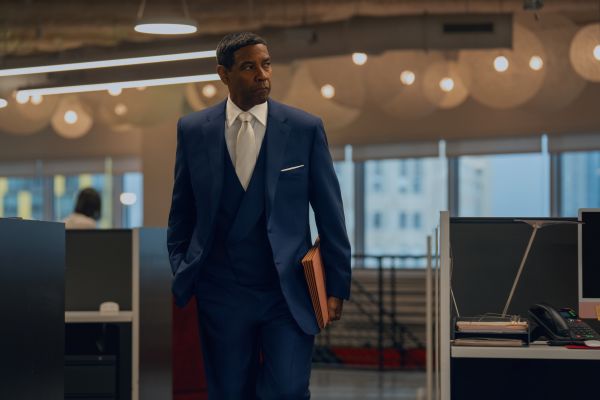
The last time Spike Lee remade an iconic work of Asian cinema, it did not turn out well. Luckily, his new film Highest 2 Lowest succeeds where 2013’s Oldboy failed, offering a fresh spin on Akira Kurosawa’s High and Low while retaining the essence of what made the original so special.
As with most Spike Lee joints, this adaptation not only updates Kurosawa’s 1963 procedural—based on Ed McBain’s 1959 novel King’s Ransom—but roots it firmly in New York iconography. Denzel Washington, in his latest collaboration with Lee, plays David King, a music mogul who rose from struggling Bronx kid to economic titan. Now he lives in a massive Brooklyn penthouse with a panoramic view of the Manhattan skyline and the Brooklyn Bridge, sharing the space with his wife, Pam (Ilfenesh Hadera), their son Trey (Aubrey Joseph), and his confidant/driver Paul (Jeffrey Wright), whose son Kyle (Elijah Wright) is Trey’s best friend. Life is good, though King worries about losing control of his struggling company, Stackin’ Hits Records, to a rival buyer who might gut its roster. His plan: buy out his partner’s share to regain control and avoid a future dominated by AI-generated music.
Fate intervenes when King receives a call claiming Trey’s been kidnapped. He and Pam cooperate with three NYPD officers to catch the abductor—until they discover the kidnapper took Kyle by mistake. The ransom demand still stands, but now the urgency shifts. King cares about Kyle, yet the child is not his; paying would mean jeopardizing his family and his business. His calculus invites both moral outrage and self-justification, as associates remind him that refusing to pay would tank Stackin’ Hits’ stock from the PR backlash alone.
Where Kurosawa’s original explored postwar Japanese class divides, Highest 2 Lowest turns its lens on the digital age. King is not a villain, but his selfish impulses are amplified by social media’s scrutiny. Washington, like Toshiro Mifune before him, balances sympathy and stubbornness, love for family and devotion to business whose love for both tests how much he’s willing to sacrifice. Washington, a master of nuance, conveys so much about King’s headspace with a mere grimace or sigh. Not that he’s lacking in monologues—the final act has those in spades, and they rock.
Matthew Libatique’s cinematography captures New York’s dual nature: gleaming skyscrapers and gritty streets, boroughs divided by economics yet linked by bridges. Lee’s love for the city permeates the film, from these contrasts to his trademark double-dolly shot, used twice here, reinforcing the theme of duality.
The film’s main flaw is its indulgence. By keeping the focus on King rather than pivoting to the police investigation, Lee devotes more time to corporate fallout and King’s personal pursuit of the kidnapper. The result is a runtime that could easily lose 10 to 15 minutes without losing impact. Sometimes less is more.
Still, Highest 2 Lowest peaks in a wildly inventive ransom exchange: The money changes hands on a subway packed with rowdy Yankees fans, while above ground the Puerto Rican Day Parade erupts in music and color. The scene weaves together King, the cops, the kidnapper’s crew, and a joyous performance by the late Eddie Palmieri (introduced by Rosie Perez and Anthony Ramos, no less) into a chaotic, exhilarating celebration of New York. In moments like this, Lee finds the film’s pulse and proves he’s still got game.






Leave A Comment