
Following Americana’s premiere at New Jersey’s Lighthouse International Film Festival, director Tony Tost described himself as a huge fan of New Hollywood cinema. In particular, he singled out an underrated movie from that era by one of Hollywood’s all-time greats: Steven Spielberg’s first studio film, The Sugarland Express (1974). While there are traces of Sugarland in Americana—namely a western road movie propelled by a tragic-yet-sweet romance—Tost’s directorial debut only half reaches its destination.
Tost is no stranger to western storytelling, having co-created Netflix’s short-lived Damnation and collaborated with Rian Johnson on season two of Poker Face, a series completely indebted to the ’70s mystery-of-the-week formula. That affection carries over here, introducing a wide assortment of oddball characters whose criminal aspirations don’t go according to plan in a neo-western setting. Yet as much as the movie borrows from pre-fame Spielberg, Tarantino, and even the Coen brothers, it never quite finds a narrative concoction where the pieces fully gel. It’s ambitious, but not always efficient.
The criminality starts out with a bang (or rather an arrowhead) when a White boy, Cal (Gavin Michael Bergman), shoots an arrow at his mother’s abusive boyfriend, Dillon (Eric Dane). He does so partly to protect Mandy (singer-songwriter Halsey), who knocks Dillon out and drives off, but also because Cal sees himself as Sitting Bull reincarnated. Obvious cultural appropriation aside, this hints at the emotional baggage weighing on this kid in rural South Dakota, who prefers to escape into fantasy rather than face reality. America’s Indigenous past becomes the inciting force that sets Americana’s plot in motion, with tragic consequences for its down-on-their-luck cast.
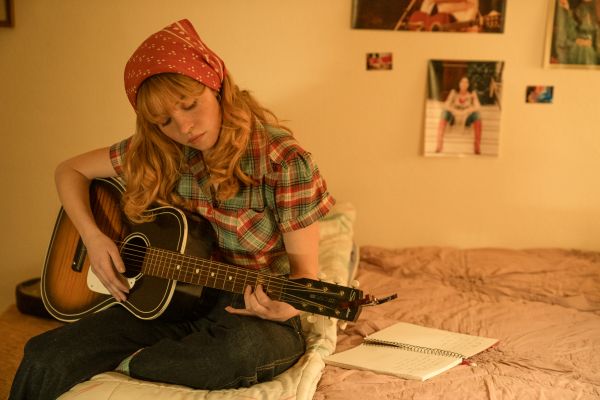
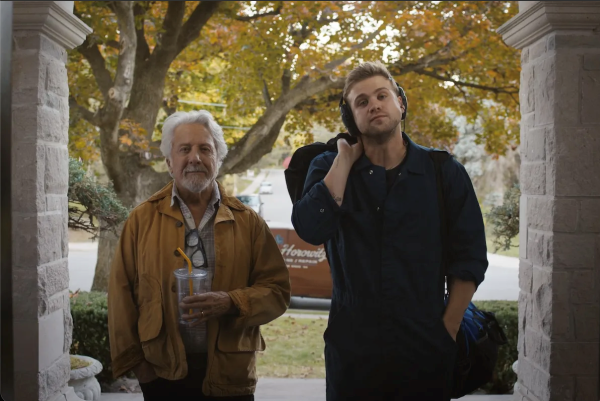
“Down on his luck” certainly describes ranch hand Lefty (Paul Walter Hauser), a man so quick to act rashly he’s already written a proposal speech to the woman he’s dated for mere weeks. This isn’t the first time Lefty’s tried this move. Yet he always has a sympathetic ear in local diner waitress Penny Jo (Sydney Sweeney), a caring but meek young woman who dreams of a singing career in Nashville—if not for her stutter and verbally abusive household. After bonding, Penny Jo and Lefty stumble upon a plan to get themselves some quick cash. That involves stealing a rare Lakota ghost shirt from a wealthy art collector, with Dillon among the crooks tapped to pull off the heist. The scheme also gives Mandy an opening to escape her wayfaring life with Cal.
Bit by bit, Americana introduces more extravagant characters as everyone converges on one location to claim the ghost shirt. These include Lefty and Penny Jo, as well as Ghost Eye (Zahn McClarnon), an Indigenous militia leader whose reaction to Cal’s reincarnation claims veers between wistful pity and deep bemusement. There are plenty of characters to juggle, and that’s before the film introduces Mandy’s misogynistic father and his disturbingly puritanical household deep in the woods. Tost’s past work suits the isolated rural setting and occasional dark comedic beats, reminding us that its hardened criminals are quite inexperienced when push comes to shove.
It’s only when the pieces begin coming together that cracks appear. For all the fun Americana has with its characters (or at their expense), it never quite finds time to flesh them out as individuals. Mandy’s reunion with her family hints at dark truths about her upbringing, but it veers into such a Handmaid’s Tale–esque direction that the cartoonish behavior clashes with the melodrama outside. This also leaves Lefty and Penny Jo’s story on the backburner far longer than expected, so our understanding of who they are to each other feels incomplete. Hauser plays Lefty as a lovable teddy bear, and Sweeney—currently stuck in a culture-war dustup over her new jeans ads—gets to try something new as a socially awkward wallflower. But for a film this sprawling, you wish Americana did more with them.
In the vein of neo-westerns, Americana carries a regretful undertone, bringing the western genre’s themes and visuals into contemporary times but stripped of Hollywood glamour. It’s an empty frontier full of struggling people—some morally dubious, others simple but kind—fighting over past crimes the country has never atoned for. Yet Tost seems more in his element capturing the look of westerns than making its standoffs matter. Still, this is a decent first-time effort. While the film takes on more ideas than it can properly explore, there’s enough allure to at least warrant a hat tip. After all, even Spielberg had to make The Sugarland Express (and Duel) before Jaws turned him into a masterful director. Small steps.

Leave A Comment