Given Embeth Davidtz’s childhood in 1970s apartheid South Africa, it’s no surprise that Alexandra Fuller’s 2001 memoir—about growing up on a farm in White-ruled Rhodesia (now Zimbabwe)—resonated so deeply with the actor (Schindler’s List) that she chose to adapt it for her impressive directorial debut. A passionate labor of love, this beautiful and painful coming-of-age tale features a powerhouse performance by eight-year-old Lexi Venter, one that may remind viewers of Tatum O’Neal’s breakthrough in Paper Moon.
While Fuller’s memoir also recounts her family’s years in Malawi and Zambia after Zimbabwe’s independence, the film opens on the eve of the 1980 election that will bring Robert Mugabe and the country’s Black majority to power. (Davidtz also wrote the screenplay.) The Rhodesian Bush War is still raging, and the White minority lives in such paranoia and fear that even a midnight trip to the bathroom fills eight-year-old Bobo (Venter) with dread. In voice-over, she whispers that “terrorists are waiting to kill you with a gun, knife, or spear.” She’s also been warned not to enter her parents’ bedroom, lest they mistake her for an intruder and shoot her. Both sleep with rifles beside them.
The next morning, as Bobo eats breakfast, the television reports the murder of another White farming family by Black terrorists. Her remote mother, Nicola (a fierce Davidtz), recovering from a hangover, casually shoots a cobra that’s slithered into the kitchen and then asks Sarah (Zikhona Bali), the African maid, to bring her tea. During the day—while Nicola works for the police reserve (a trip to town for the White farming community requires an armed escort), and her husband, Tim (Rob van Vuuren), is away fighting in the war—Bobo and her sullen teenage sister, Van (Anina Hope Reed), are left to fend for themselves on the hardscrabble farm.
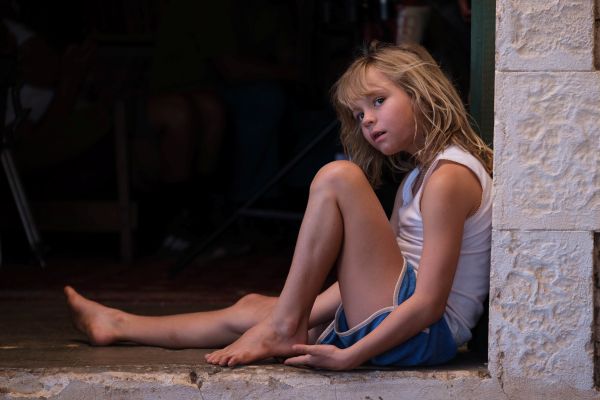
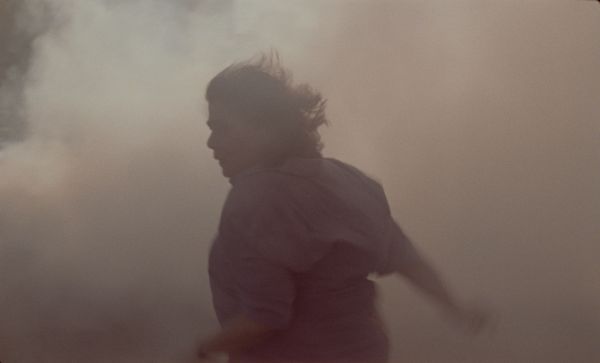
With her dirty face and tangled hair, the feral Bobo steals cigarettes from her absent parents and roams the farm and nearby village on her motorbike, a rifle strapped to her back. She stares imperiously at the villagers and barges uninvited into Sarah’s home. Sarah greets her with both affection and discipline. But Jacob (Fumani N Shilubani), who also works for the Fullers, is less charmed. Having heard Bobo parrot her parents’ racist views, he tells Sarah, “She thinks you’re a stupid village girl.” He fears that Sarah’s close association with a White family makes her a vulnerable target.
Davidtz’s sharp-eyed portrait of colonialist entitlement is underscored in town scenes of Whites playing cricket and enjoying a suburban lifestyle, even as Black prisoners are tortured in the police station where Nicola works. During a visit to her grandparents, Bobo recoils from her incontinent, stroke-ridden grandfather, covering her face so she doesn’t have to look at him, and boldly asks, “Are we racist? What sort of people are we?” Her grandmother replies, “We have breeding, which is better than money.”
The title, Don’t Let’s Go to the Dogs Tonight, translates to “let’s not allow things to get worse.” But life does worsen for the Fullers after the election results usher in a newly independent Zimbabwe and a Black-led government. Quivering with rage and grief, Nicola becomes determined to hold onto her land—and in the most brutal and shocking scene, she confronts a group of squatters on her property. Terrified, Bobo shouts at her mother to stop.
By shifting Fuller’s memoir from an adult’s reflective voice to Bobo’s immediate, present-tense perspective, Davidtz vividly captures a child’s confusion and the dissonance between what she sees and what she’s told. She’s ably supported by cinematographer Willie Nel, who keeps the camera at Bobo’s eye level, and by production designer Anneke Dempsey, who avoids romantic Out of Africa clichés in portraying the Fullers’ chaotic, ramshackle world, one barely more secure than that of their Black African neighbors.
If the film has a weak spot, it’s in its portrayal of the saintly Sarah, which comes dangerously close to the Magical Negro trope, where a Black character serves as a moral compass for flawed White protagonists. Despite this shortcoming, Davidtz proves herself a quadruple threat as director, screenwriter, actor, and producer. Don’t Let’s Go to the Dogs Tonight is a riveting watch.
Leave A Comment