
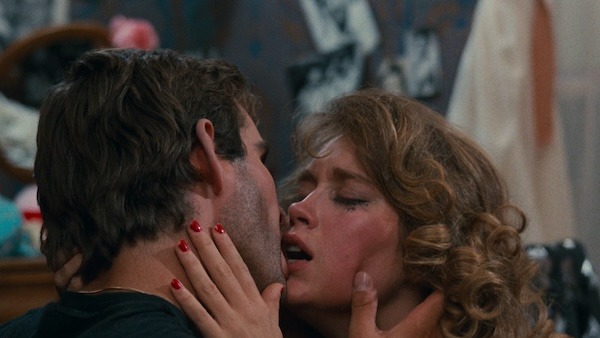
Paul Vecchiali’s newly restored 1986 film is a Paris-set, candy-colored—though melancholic—portrait of a young sex worker, Rosa (Marianne Basler), who, on the cusp of turning 20, finds herself at a crossroads. Vecchiali’s script follows the structure of a Shakespearean tragedy: early party scenes are joyous, comic asides lighten the tone, and a colorful array of supporting characters offer insights into the protagonist, even as the storyline hurtles toward doom.
The memorable opening sequence flips through dark, blue-tinted stills of city streets while composer Roland Vincent’s aching electronic theme plays over the credits—a motif that returns throughout, including at a critical moment when Rosa first glimpses a potential love interest, Julien (Pierre Cosso). In an early morning park scene, two middle-aged sex workers, credited only as Quarante (Catherine Lachens) and Trente-cinq (Évelyne Buyle), dryly bemoan Rosa’s youth and her luck at attracting men, lamenting their own status as little fish in the sea, dismissed by passersby. Though the pair are amusing, they slowly fade from focus as the film becomes more and more enamored with Rosa.
Also in the mix is Rosa’s 50-year-old pimp, Gilbert (Jean Sorel), who is all business: matter-of-fact and stoic. What seems like a glimmer of kindness—buying Rosa a fur coat for her birthday—feels purely transactional. Knowing how lucrative she is, he wants her to work for five more years so that he can retire. Rosa, however, is reluctant, yearning to be free.
Rosa’s outfit—a royal blue dress with front lacings and red plastic hoop earrings—is striking. Having recently seen Jean-Luc Godard’s A Woman Is a Woman, I couldn’t help but think of the similarly bold use of color—the bright blues and juicy reds—from that film. These colors suggest a sense of carefree splendor that becomes ironic and dissonant as Rosa grows more and more distraught by her work. In contrast, most of the side characters wear muted tones and drab clothing—though Quarante seems to cling to a fading sense of youth in an ill-fitting red dress. Trente-cinq, the quieter and less vivacious of the two, is dressed mostly in black, including an androgynous tuxedo look at Rosa’s birthday, reminiscent of Julie Andrews in Blake Edwards’s Victor/Victoria. Julien, the handsome city worker, appears in a faded white denim jacket and black T-shirt, echoing the black-and-white photo of 1950s-era Marlon Brando that adorns Rosa’s dressing table. (The vivid costuming is by Nathalie Cercuel and Antoinette Dimanche.)
Basler’s performance seems fizzy and fluffy at first but quickly deepens into something more complex and stinging. There’s a playful scene of seemingly innocuous roleplay, as well as a moment when she beds a naïve, virginal teen (Laurent Lévy) who had previously followed her awkwardly around the city. But Rosa’s years of being commodified, coupled with her uncertain future, register in the trapped sadness on Basler’s face. The shattering ending, which fuses doom with the hope of a morning sun, is a triumph of both acting and Vecchiali’s evocative cinematic language.

Leave A Comment