
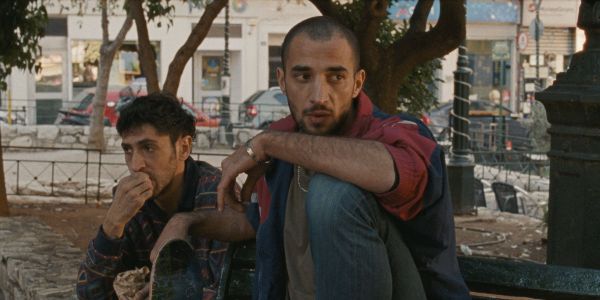
A little after halfway through To a Land Unknown, a drug dealer, Abu Love (Mouataz Alshaltouh), begins quoting the Palestinian poet Mahmoud Darwish. Abu is a wannabe poet and Palestinian refugee who has recently gotten himself involved in some highly immoral—even sadistic—activity with cousins Chatila (Mahmood Bakri) and Reda (Aram Sabba). The poem is famous, often referred to as “The Mask Has Fallen,” and describes the triumph of entropy, when those who “have no brothers” are forced to strike out violently without restraint. Abu speaks the words with a smile, as though they have nothing to do with him or his actions. It’s a rare heavy-handed moment in a compelling film that is distinguished by its unerring focus on characters and situations that filmmaker Mahdi Fleifel allows to speak for themselves.
Chatila and Reda, Palestinians who have left their families behind in Lebanon, are stuck in Athens, trying to get passports. Their dream is to reach Germany, where they hope to open a café and earn enough to bring their families overseas to safety. Chatila is the brains and cunning behind the endeavor—he’s the one hiding their money in a gap in the wall, the one meeting with a black-market dealer in fake passports, and the arranger of their transport. Meanwhile, Reda struggles with a heroin addiction, yet he’s also more compassionate and reluctant to make moral compromises. Their options for raising money are limited. Chatila frequently steals; Reda sometimes has sex for euros with men in the park. They currently live in a crumbling concrete building with other refugees. They Facetime their loved ones, telling partial truths, if that. (Chatila has a wife and son.)
An unlikely opportunity presents itself when a young boy, Malik (Mohammad Alsurafa), an orphan fresh from Gaza, latches onto them, looking for help. He’s trying to get to Italy to unite with his aunt, who is unwilling to send money for transport after being scammed the last time she tried. Chatila, who initially tries to get the boy to leave, persuades a lonely Greek woman, Tatiana (Angeliki Papoulia), to act as his mother so she and Malik can travel to Italy with fake passports. Before the end, their schemes will have become exponentially more dubious and grotesque.
The film is remarkable for the emotional reality the principal players bring to their roles, for the way co-writer and director Fleifel neither fully excuses nor fully demonizes them, and for his refusal to overexplain their circumstances (the exile of so many Palestinians) to the audience. This is especially striking in a film with such a politically charged subject. The Athens he portrays is one of crumbling, graffiti-covered buildings and desperate people, all shot unflinchingly and rendered with atmospheric precision.
It should not come as much of a surprise—though I’ll refrain from spoiling the specifics—that the cousins become involved in a scheme so morally bankrupt and sadistic that they end up victimizing refugees like themselves. This is a decision the director makes with clear purpose: to expose how a dehumanizing reality can lead the sufferers to dehumanize others in order to survive. There are striking aspects to how he handles this—the cousins’ contrasting personalities and impulsive behavior are rendered chillingly, and these scenes gain texture from the fact that few of the perpetrators seem willing to accept they’ve crossed a line. However, once the film has made its point, it gets stuck there, unsure where to go next, and takes a little too long to get there.
It’s a misstep that’s frustrating but not fatal, and one trusts that this filmmaker will find more imaginative ways to move forward with his material in the future. To a Land Unknown still lingers in the mind for the clarity with which it brings both the ugly and the beautiful aspects of Chatila and Reda to light.
Leave A Comment