
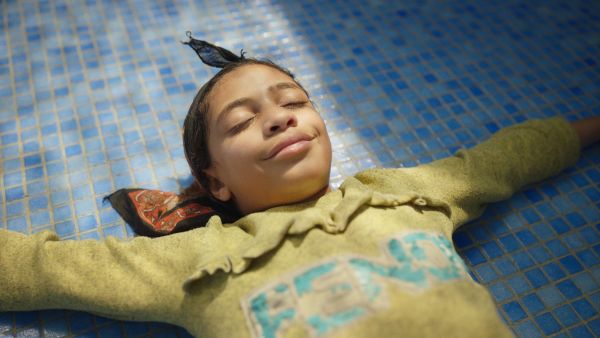
In developing countries like Egypt, many children—particularly from rural areas—are forced into labor in urban households. According to the International Labour Organization, approximately 17.2 million children worldwide are engaged in paid or unpaid domestic work, with girls making up 67.1% of all child domestic workers. Toha (Doha Ramadan) is one of those millions of girls whose stories often go untold.
Director Sarah Goher’s striking debut feature tells Toha’s story from her own perspective, capturing both the affection she feels for her host family and the stark injustice of her circumstances. Toha is illiterate, doesn’t attend school, and is expected to perform hard labor at the beck and call of Leila (Nelly Karim), a single mother in Cairo who serves as her “host.”
The film shows a range of reactions to Toha’s situation—from the disdain of a retail worker to the cold indifference of Toha’s biological mother. Toha herself doesn’t fully grasp her position. At the same time, viewers come to understand the complexities of Leila’s household—a petty-bourgeois family teetering on the edge. Leila, navigating a troubled marriage, cannot afford an adult maid but is determined to maintain the illusion of middle-class respectability. The bittersweet interplay between Toha’s naïve optimism and Leila’s shame and denial gives the film a rich emotional undertone.
The film succeeds both as a sharp social critique and as a traditional Middle Eastern drama in which a young girl encounters a world of luxury previously unknown to her. While helping to plan a birthday party for Leila’s eight-year-old daughter, Toha finds herself enchanted by the bright dresses in upscale stores and the dazzling attractions of an open-air mall. Her deep longing for a single birthday wish tempers the audience’s horror at her mistreatment.
As the story progresses, Goher subtly weaves together two spheres of Toha’s life: her strained home environment and her work preparing for the party. Although the film takes place over just one day, Toha endures enough hardship—and reveals enough resilience—for it to feel like the journey of a lifetime. Her path through various obstacles, errands, and quiet acts of rebellion recalls the emotional realism of Italian neorealist films like Bicycle Thieves.
Doha Ramadan gives a deeply honest performance, perfectly embodying Toha’s quiet strength and curiosity. The film resists sentimentalism, refusing to reduce Toha to an object of pity. Instead, it gives her depth, agency, and a fierce determination. Goher’s direction handles a challenging, often overlooked subject with restraint and sensitivity, avoiding the pitfalls of exploitation or “misery porn.” The result is a thoughtful, clear-eyed film that critiques the system while honoring the resilience of its protagonist.
Happy Birthday won Best International Feature Film and the Nora Ephron Award at this year’s Tribeca Festival.





Leave A Comment