The release of 28 Days Later (2002), at the dawn of a new decade (and a new century), revived the zombie film like nothing had since George A. Romero’s contributions. It smartly and fiercely revitalized the horror genre in an era where quantity outweighed quality and brought Danny Boyle back as a vital creative force after the critical and commercial disaster of The Beach. It also served as a significant showcase for the emerging possibilities of digital cinema. Two decades later, the impressive sequel 28 Years Later arrives in a not-so-different landscape: It’s hard to remember the last time a zombie film truly gripped audiences with raw, visceral terror. The horror market is oversaturated with weekly releases that are instantly forgettable. Once again, Boyle’s visual imprint unleashes the limitless possibilities of digital filmmaking and current technologies—primarily shot on iPhone 15 Max—tapping into their convenience, speed, and, yes, even their arguable beauty with clear-eyed vision.
It begins with a sinister opening, full of cynicism and brutality: a group of healthy children huddle in front of a TV, watching The Teletubbies while trembling with fear. Something terrible is happening outside, and the adults won’t be able to hold it back for long. Only one child survives. We don’t need to see the massacre—imagining it and hearing it is stomach-turning enough. The perpetrators of this violence are humans infected with a virus that turns them into mindless, ravenous creatures. Blood spreads the infection, and those who don’t die remain like the living dead, wandering the earth, driven only by what they can kill and devour. As in the original, the word zombie is never uttered, and once again Boyle—working with Alex Garland (returning as screenwriter)—focuses not only on the carnage but on the aftermath, and how humanity manages to survive and move on.
For continuity’s sake, it’s worth recalling that there was a second installment in 2007 (28 Weeks Later), though Boyle and Garland weren’t involved. In any case, the new sequel seems directly connected to the original, maintaining the idea (or cruel joke) that England remains quarantined from the rest of the world, which has gone on with life, untouched by the tragedy. Nearly three decades have passed—enough time to restore a semblance of normalcy. The surviving English have built an agrarian, livestock-based society on a small island, lacking the resources and technologies once available. They remain isolated, but the territory has a guarded perimeter that leads to a narrow strip of land (accessible when the tide is low), connecting directly to the mainland, where the infection still rages and the infected dwell. As part of a coming-of-age rite, some must occasionally venture into the mainland to hunt the infected and return as surviving heroes. Jamie (Aaron Taylor-Johnson), experienced in crossing over, believes his 12-year-old son Spike (Alfie Williams) is ready for initiation. His mother, Isla (Jodie Comer), is physically ill and mentally unstable, so her resistance to the idea only breeds tension. The boy, meanwhile, thinks he’s ready—at least, he doesn’t want to disappoint his father.
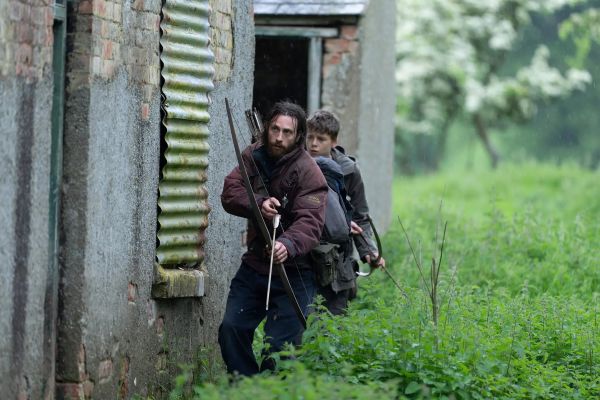
The first half of the film focuses on this father-son journey into infected territory. Each action set piece is visually striking and terrifying—from Spike’s first hunt under Jamie’s supervision, with the infected crawling through the grass like naked grey worms, to a harrowing open-field chase that ends with the pair hiding on a rooftop. Rest is brief, and waking reality is as nightmarish as dreams, soaked in blood-red hues and other visual flourishes. Jamie insists there are lessons to be learned in this reckless adventure, but the whole endeavor seems designed only to risk their lives for the sake of bragging later. Maybe there is a lesson for Spike after all: Adults lie, and there are other kinds of monstrosity in those who still call themselves human.
The second half centers on a return trip to the mainland, this time with a nobler mission: Spike decides to accompany his mother in search of Dr. Ian Kelson (Ralph Fiennes), hoping he can help with her illness. The journey is filled with extreme situations and further encounters with the infected. When Fiennes finally appears, the film takes a more philosophical and mystical turn, as we meet this benevolent Kurtz–like figure who has built a temple to death, both as home and future mausoleum.
With world-building intensity, this sequel—also the first chapter in a new trilogy—initially delivers on the blockbuster expectations of a summer release. But what transcends here is Boyle’s refusal to lean on easy images, sounds, or sensations designed to simply fill seats for a weekend and fade into obscurity. Anthony Dod Mantle’s cinematography embraces vibrant color. Even the darkest scenes retain a haunting richness (a chase under the aurora borealis is breathtaking). Jon Harris’s editing is dynamic and unpredictable, enabling experimental choices that heighten anxiety rather than distract. Meanwhile, a score by Young Fathers adds punk energy—sometimes playful, sometimes adrenalized.
It may be too soon to call it superior to the original, but at the very least, it’s fair to say that Boyle is back with one of his best films to date, once again sidestepping Hollywood’s expectations and conventions (this is, first and foremost, a British production). 28 Years Later is a hellish postcard—violent, stressful, frightening—yet unafraid to be subtle and character-focused between the scares. Within its contained end-of-the-world scenario, it still finds room for hope and mercy.

Leave A Comment