
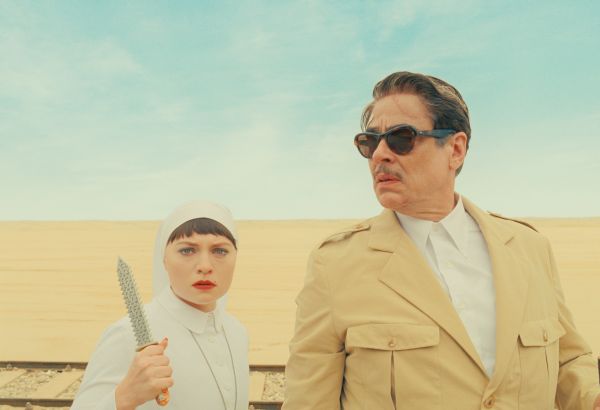
Watching a Wes Anderson film is an invitation to get pleasantly lost. Such a treat implies that our imagination is actively engaged with the often meticulous and detailed tableaux vivants, in which the viewer’s eye can roam freely. One must also pay attention to the elegant and, at times, intricate storytelling, where many things happen at once, witty lines are delivered at a quick pace, and numerous characters come and go as they please—embodied by some of Hollywood’s most recognizable faces.
Anderson’s new film gives us that familiar “business as usual” sensation we’ve come to expect from his recent work. However, compared to his previous two features (The French Dispatch, Asteroid City), this one feels slightly more modest in its intellectual gymnastics—more in line with his pre–Grand Budapest Hotel work: a comedy with an open heart and a rich visual world, constructed through exquisite art direction and cinematography. Set in 1950, with an original story co-developed with Roman Coppola, the film plunges us into the hectic and dangerous life of Zsa-Zsa Korda (Benicio Del Toro), a billionaire businessman dodging countless assassination attempts.
Aboard a plane, an explosion slices his assistant in half (leaving the lower half seated, surrounded by a splash of blood), while Korda fires the pilot mid-air to land the plane himself after a punch-up between the two, sparked by a misunderstanding. Even with its comedic tone and theatricality, this is arguably one of the most violent and heartless sequences Anderson has ever dared to film. Yet it serves as an immediate portrait of his ruthless and cold protagonist.
Aware that he could die at any moment and burdened by the sheer number of enemies, Korda realizes the time has come to get his affairs in order. The matter of legacy that arises isn’t limited to his considerable fortune or its division among his eight children, all of whom are kids or preteens living in his main estate. There’s something deeper—and paradoxically more vital—in this memento mori, leading to a quest for redemption and a moral reckoning that Del Toro and Anderson convey through action, close-ups, and occasional theological metaphors staged in the abstract space of a paradise (these hallucinatory black-and-white sequences are intercut throughout the narrative). Korda sends for his eldest daughter, Liesl (Mia Threapleton), a novice nun who has not yet taken her vows. He intends to name her the sole heir of his fortune and enlist her help in completing the project that gives the film its title—a race against time that takes them across continents and to encounters with eccentric characters.
Korda suspects his brother Nubar (Benedict Cumberbatch) is behind the assassination attempts—who may or may not be Liesl’s biological father, and may even have had a hand in her mother’s murder. He warns Liesl, whom he considers his daughter regardless of blood, that her uncle “is not a man, he’s biblical.” This is just one of many memorable aphorisms, like his main motto: “If something gets in your way, flatten it.” (That phrase could very well serve as an aesthetic manifesto for the director’s filmography.)
Meanwhile, the Phoenician scheme refers to the various deals Korda must seal to secure funding and complete an ambitious engineering project that could benefit humanity and remain financially viable: an intercontinental transport system linking train routes through mountains, deserts, and canals. In classic Anderson style, listening to the explanation—and watching the process unfold—is far more satisfying than knowing whether he’ll succeed or survive to tell the tale.
The journey allows for a parade of new and familiar faces from Anderson’s ever-growing troupe: Bryan Cranston, Tom Hanks, Scarlett Johansson, Riz Ahmed, among others. And there’s a hilarious cameo from Bill Murray. Yet none of the stars overshadow Del Toro’s performance. Korda, desperate to make amends with his daughter, gradually softens his megalomaniacal ways, knowing full well that this time, money won’t be enough. As a relatively unknown face among this star-studded ensemble, Threapleton is the film’s soul, grounding its eccentricity with emotional clarity. Meanwhile, the standout scene-stealer is Michael Cera, in a role that turns out to be dual—and is better left unspoiled. Cera seems tailor-made for Anderson’s cinematic world, which might mark the beginning of a fruitful collaboration.
The Phoenician Scheme is structured through a series of visual gags and star-filled interactions. A basketball game, a terrorist siege, and quicksand escapades are part of the colorful set of adventures during its brisk runtime of under two hours. But it’s the character study of Korda and the father-daughter relationship that ensures we don’t mistake its lightness for frivolity. At a time when portrayals of powerful men in fiction often skew Trumpian (or Muskian), it’s intriguing that Anderson chooses to explore compassion and regret. This side of his escapism is refreshing, especially considering how the opening scenes hinted at a much more nihilistic path.
By now, we know well the joyful trip we embark on when entering Anderson’s cinematic worlds, and we gladly anticipate many of his signature moves. It would be unfair to say his unique gaze has become formulaic or lost its power to surprise. On the contrary, the deeper Anderson delves into the labyrinths of his own aesthetic, the more unexpected delights he unearths, and the more fully he fuses form and content to make it clear that one cannot thrive without the other. His cinema is as human as it is biblical these days. Also, this is the first time God makes an appearance. You’ll see.









Leave A Comment