
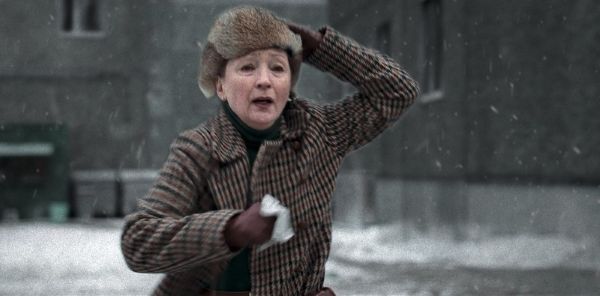
You could say that psychiatrist and author Dr. Joan Andrews (Lesley Manville) lives in a world of her own devising. This is not to say that her concerns are necessarily insular or trivial. Her controversial works are well-known both in her native England and abroad. She proposes that schizophrenia is not a mental disorder but the result of social control. In search of a new form of treatment, she has pioneered a method in which the doctor lives in the company of the afflicted, treating patients as equals. (R.D. Laing is a likely real-life model for these theories.)
Yet one can’t say her behavior toward the majority of her peers is much more than callous and dismissive. Eager graduate students are brushed away. Chaperones are spoken to tersely and without compassion. When she steps behind the Iron Curtain on an invitation to a conference in Warsaw in December 1981, she has clearly given no thought to what is happening in the country—she is even obtuse enough to expect room service. Meanwhile, the Solidarity movement is gaining ground, and martial law will soon be imposed as a result. Just before this happens, a planned protest against the repressive state interrupts Dr. Andrews’s lecture.
Kasia Adamik’s film immediately turns into a nightmarish political thriller. Dr. Andrews is shuffled through various apartments under siege. She narrowly escapes from the secret police, whose mission she scarcely understands, and becomes an accidental witness to multiple deaths, which she records on her Polaroid camera. Throughout, she harries the political dissidents with demands to be taken to the British Embassy. In the end, it is as much a thriller as a story of personal change—from self-absorption to a concern for the welfare of others in practice rather than theory.
Hitchcock’s old enemies, “the plausibles,” just might have a field day with this one. Quite a few details in this dark and tense tale strain credibility. Why exactly would dissidents use this academic setting as a setup for a protest? (There is an answer of sorts: Dr. Andrews’s theories have some relevance to the status of oppressed peoples, yet to me this felt somewhat tenuous.) Also, would an academic in the 1980s really be so obtuse as to assume there would be room service behind the Iron Curtain? More crucially, can we really expect this professor to be so competent in defending herself against one of the secret police that she actually succeeds in killing him? (I will admit that I thought this scene was kind of awesome.)
Nevertheless, by and large this film compels more than it frustrates. Certainly the stark photography and claustrophobic design of the gray buildings create a striking atmosphere. Certainly the pace never flags, and the performances are all strong. Yet the film’s greatest asset may be not only Manville’s brilliant performance—a complex mixture of solipsism, deep emotional wounds, and reluctant compassion—but also its engagement with the least flattering aspects of her character.
Dr. Andrews, even in the most high-stakes situations, even when confronted with dead bodies and tanks in the street, clings violently to her sense of entitlement, using every opportunity she can to badger the members of Solidarity to bring her to safety. It isn’t merely that she wants to get away: She is still convinced that everyone owes her the treatment of an honored guest. And because Manville is such an expert actor, this behavior is both appalling and, uncomfortably, relatable. Our multifaceted view of Dr. Andrews is enhanced by the fact that we always see the Polish dialogue, which she does not understand, in English subtitles.
It will be interesting to see how Winter of the Crow ages, whether time lets us excuse its gaping flaws (which include some very corny lines about the power of imagination against totalitarianism) or revel in its many strengths. I do feel confident, however, that this engaging thriller is worth your time.








Leave A Comment