
Time loops in movies are rarely just a supernatural occurrence. They tend to have a larger, often psychological meaning connected to the protagonist’s growth, from Groundhog Day pushing Phil Connors to change his ways to Edge of Tomorrow making William Cage grow a backbone. It Ends might not be a time loop movie in the traditional sense, but it succeeds in creating a metatextual angle to the question of what these kinds of traps mean within an existential nightmare.
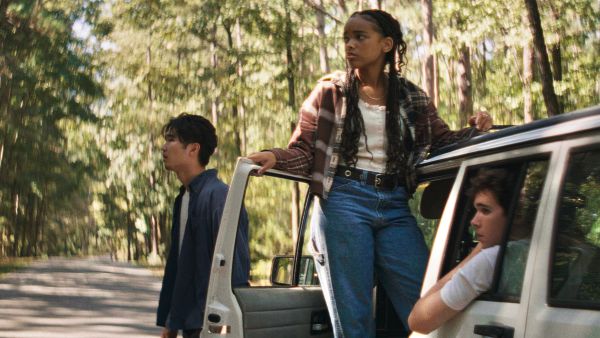
Getting caught on an endless road trip was never on the radar for James (Phineahas Yoon), Fisher (Noah Toth), and Day (Akira Jackson). Initially, this trio of recent college graduates was just happy to reunite with former classmate and ex-veteran Tyler (Mitchell Cole), who went out of his way to pick them up in his Jeep. Their initial conversation, while peppered with uncertainty about the future, is mostly a nonsensical debate on who’ll emerge victorious in a battle of hawks, rats, gorillas, and an armed human. Perhaps it’s that uncertainty regarding their futures that sets things off, as before long, the passengers realize a turn in the forest they’re driving through never appeared. The path just keeps on going, infinitely.
Trying to turn around proves ineffective, as the path Tyler was previously on is now blocked off by trees. Worse, if they stop the car for too long, random humans emerge from the woods and attempt to chase the foursome down like World War Z zombies. Whether it’s to kill them or simply steal the car is never made clear, but the conclusion is the same: keep driving forward through the woods until something—anything new, really—happens. Especially since, even with regular day and night cycles, our victims don’t seem to require food, drink, or even gas for the car to keep on moving.
Questions are raised about where exactly this takes place: the afterlife, purgatory, maybe punishment for a past misdeed? James, in particular, seems desperate to discern some logic for their endless predicament, if only so any clue might help them escape. But for It Ends, escape is less of a factor than the stress test it subjects its victims to, questioning how long the quartet can keep going before everyone accepts defeat and acknowledges there’s no way out.
Without spoiling too much, It Ends uses this test of wills as an excuse to play with its own genre. Midway through, the movie evolves into a dark road trip comedy, with the characters growing so used to their predicament that this nightmare recedes into the background for casual conversations and scavenging trips. Not to mention regularly scheduled break periods dedicated to getting out of the car and yelling at the sky in frustration. It’s a slightly lighter affair than the first part, but only in terms of tone. The same questions of what they are doing here persist—the difference is whether finding answers ultimately matters.
The feature film debut of Alex Ullom makes for a confident first impression. It quickly hooks your interest in a cast of unknowns and, within a short runtime, establishes a twisted set of rules to keep the plot literally moving forward. That lack of information is key; the more left up to the viewer’s imagination, the more invested we are in the hows and whys of this forest and what it represents. Ullom’s direction, combined with Evan Draper and Jazleana Jones’s eerie cinematography, goes a long way to make the never-ending forest and road feel inescapable, transforming the familiar into a stressful and dispiriting, yet occasionally goofy, odyssey.
However, the film somewhat stumbles in defining its passengers beyond their choices on the endless road. Bits and pieces of James, Day, and Fisher’s lives are dropped throughout, while two major conversations are dedicated to exploring Tyler’s insecurities and why he left their friend group. Yet the movie defines them by their breaking points and what that says about each person adjusting to such a nightmarish turn of events. It’ll certainly endear you to all four, but only to a point, and I wish we weren’t left with a depiction of bonds that only feel half-complete, despite all the barriers they endure together.
That It Ends successfully builds its own mini-horror limbo on limited resources is a testament to Ullom’s ingenuity, right down to a final dark joke linked to the title. However limited the characterizations feel compared to its worldbuilding, the final project makes Ullom and his cast worth keeping an eye on. For all ways the scenario manifests fears of an uncertain future, everyone behind the wheel of this story is undoubtedly a potential breakout star.




Leave A Comment