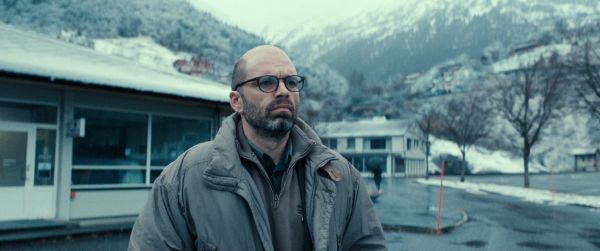
Morals and institutional ethics collide in Cristian Mungiu’s richly observed, Palme d’Or–winning Fjord, perhaps the most accessible work by the Romanian director. It follows a family caught in a quagmire of legal trouble after moving from Romania to a remote Norwegian village. Relocating with four school-age children and an infant, Mihai (Sebastian Stan) and Lisbet Gheorghiu (Renate Reinsve) chose the country to be closer to Lisbet’s family. However, complications arise as they continue to practice their conservative Evangelical Christianity, a lifestyle that clashes with the firmly secular, progressive society.
At first, the older children appear happy and are open about their religious beliefs at school (sometimes to the consternation of the faculty). However, a gym teacher notices bruises on the back of the eldest daughter, Elia (Vanessa Ceban). Soon after, a school employee overhears Elia and her brother Emmanuel (Jonathan Ciprian Breazu) discussing domestic punitive actions. Assuming the worst, she reports the family to child services, beginning a bureaucratic nightmare of investigations and forced separations. The system appears to be driven by an underlying cultural bias, where the family’s foreign identity and religious values are scrutinized more than anything else.
The film is loosely inspired by the 2015 case of a Romanian-Norwegian couple whose five children were taken into state custody after allegations of corporal punishment.
Elia and Emmanuel seem like ordinary adolescents, initially unfazed by their faith-based, circumscribed lives. However, they befriend their neighbor’s rebellious and worldly daughter, Noora (Henrikke Lund-Olsen), who coaxes them into mischievous antics, like escaping out a window for a late-night boat ride. Mungiu lets a quiet tension hover in the background, as the implications of the relationship between Elia and Noora threaten to confront the family’s belief system.
As Mihai, Stan plays a father who initially seems like a gentle soul—until he pounds an ax into a log, demonstrating an inner rage. Desperate to salvage his custody battle, he involves right-wing Christian activists. Their protests quickly hijack the local media, causing their sympathetic neighbor and legal counsel to question the couple’s true behavior at home.
What really happened within the household is never verified, putting the audience in the position of judging for themselves, as they might with any family’s life behind closed doors. Here, the authorities assume the worst to a shocking extreme, even using a Romanian proverb about the positive nature of a beating as evidence of misdeeds. That the family eschews modern technology, such as cell phones, is also treated as confirmation of parental abuse.
How far can a parent go to discipline a child? What about slapping a child to avoid scalding a baby, as in this case? The Norwegian judicial system is presented as overly rigid, occasionally pushing the boundaries of believability, such as insisting that the nursing baby be separated from its mother. Nevertheless, the film succeeds as a cauldron of questions—a masterful exploration of the continuum of justice, assimilation, and tolerance.
Excellent performances enhance these weighty themes. The career of Romanian-born Stan is marked by a wide variety of character roles in which he often transforms physically, including here, with a shaved head and light beard. (His past roles include Donald Trump in The Apprentice, a man with a disfiguring facial condition in A Different Man, and Tommy Lee in the television series Pam & Tommy.) Reinsve, best known for her work in Joachim Trier’s films such as The Worst Person in the World and Sentimental Value, is also almost unrecognizable in modest clothes and glasses. She delivers an effective, understated performance.
Working with cinematographer Tudor Vladimir Panduru, Mungiu captures the stunning yet icy isolation of Norwegian landscapes. Paced like a white-knuckle courtroom drama, Fjord is a disturbing look at a family under siege.
Following its debut at the Cannes Film Festival and a stop at the prestigious New York Film Festival, Neon will release the film in theaters on October 9.







Leave A Comment