Director Tamara Kotevska was nominated for two Academy Awards for her debut documentary, Honeyland: best international feature and best documentary. She returns with a compelling and moving portrait of a vanishing way of life in her native, largely agricultural North Macedonia. Without a doubt, she has suffered no sophomore slump.
Viewers may initially not know where the film is going as it begins with the financial strife of a farming family headed by Nikola. He and other neighboring farmers are losing money. The worth of their crops—tomatoes, corn, and tobacco—are starkly undervalued by traders and buyers. Three tons of potatoes from Nikola’s farm are left unsold and headed to the dumpster.
His adult son has moved away and hasn’t returned. The second story of Nikola’s home, which he started constructing for his son, has been left unfinished. (In the Q&A after its North American premiere at the Toronto International Film Festival, the director said that villages throughout the country are filled with unfinished second stories.) Meanwhile, Nikola’s daughter and her young family move to Germany to make a new start in the restaurant business, with Nikola’s wife, Jana, following. Throwing in the towel, Nikola puts his properties up for sale. However, at 60 years old, he is too young to retire, but too old to change professions.
Meanwhile, his village, Cesinovo, has the highest number of storks in North Macedonia. Considered wild animals, they are illegal as pets. They nest on roofs and chimney tops, feasting on mice. And poor frogs don’t stand a chance. With cinematographer Jean Dakar’s long lens, viewers witness the cruel cycle of life as storks tear up and gobble down the amphibians. (No AI was used; the storks got used to the camera-laden drones, according to Kotevska.)
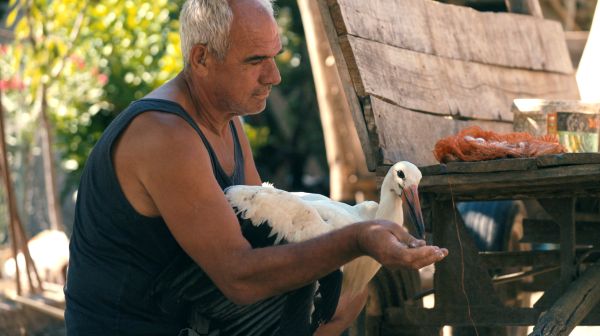
Storks are drawn to large, noisy machines, like tractors, because they know food is nearby. Unfortunately, that also draws them toward bulldozers in landfills, and consuming plastic and rubber endangers the birds. At a garbage heap, Nikola finds a majestic adult stork with a broken wing. He picks it up, caresses it, and takes it home. In his interactions in nursing and caring for the gangly bird, Kotevska and Dakar capture incredibly intimate moments between humans and animals.
Tying the threads together is the legend of Silyan, which dates at least to the 17th century, where a young boy wanted to leave the hard-knock village life for greener acres, but was cursed by his father for abandoning him. The result: The boy is struck by lightning and becomes a stork. Made over the course of three years, the documentary unfolds organically. In fact, Kotevska was six months into production when she started blending the Silyan folktale into her film. As depicted here, storks are accepted as members of the community. Captivating and meticulously filmed, The Tale of Silyan stands out among the documentaries this year.
The Tale of Silyan has been acquired worldwide by National Geographic Documentary Films.




Leave A Comment