For his latest film, director Park Chan-wook takes as his blueprint Donald E Westlake’s lean and mean bloodbath The Ax (1997) and makes the macabre and cynical tale his own. Given the three-decades gap between the book and film—now set in present-day South Korea—there are notable changes. The former was published a few years after the NAFTA agreement, when American companies began moving abroad to save money, and took place in the growing Northeast Rust Belt. Instead of reproducing the novel’s anger and economic anxiety, Park tweaks the material, giving it more of a bumbling comedic, farcical flair. (If the global economy radically changes in the near future, this film may become prescient and a sign of anxieties to come.) Westlake’s book was also previously adapted in 2005 by Costa-Gravas, to whom Park dedicates this film.
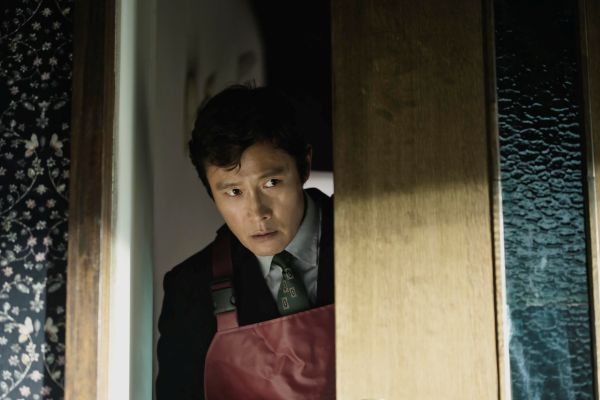
Man-su (Squid Games’s Lee Byung-hun) lives in a verdant suburban paradise with two kids, an adoring wife, and two frolicking golden retrievers. He’s first seen grilling eel, a thank-you gift from his employer of 25 years, Solar Paper: He was the 2019 Pulp Man of the Year. Even before he recognizes his good fortune—he exclaims, “I’ve got it all,” during a family group hug—viewers can begin counting down to the moment when he will have the rug pulled out from under him. After his company is bought out by a cost-cutting American corporation, Man-su immediately loses his managerial position. Now his family must downsize. No more Netflix, and the kids have to say bye-bye to the dogs. Months later and facing foreclosure, he and Mi-ri (Son Yejin) put their haven on the market, the home where he was born.
Nearly 50 years old, Man-su faces a tough job market. His nervousness—job interviews take practice—causes him to blow an opportunity. Spewing nonsensical answers with his knees shaking, he melts under pressure. At another paper company, he follows a higher-up to the men’s room and begs on his knees for reconsideration. Out of luck, he stumbles upon a plan first innocuously suggested by his wife. Joking about another middle-aged, though employed, manager, she asks, “Can’t he be hit by lightning?” Man-su’s idea? To take out his competition for an ideal job. He posts a help-wanted ad in an industry magazine and combs through the submitted resumes to identify those most likely prospects/competitors to take a managerial opening at a nearby paper manufacturer.
Unlike the worried wife in the novel, Park beefs up the wife’s role to become not quite Lady Macbeth, but at least complicit in her husband’s impending crimes. Park’s best innovation is perhaps Man-su’s entanglement with a self-centered vain actress (played by Yeom Hye Ran; Is there any other kind?) who becomes inadvertently involved in his mission’s first foray. She’s just as determined to off a guy as Man-su. Park also adds a turbulent backstory for Man-su, hinting at a family history of depression, as well as a MacGuffin, a North Korean–made firearm.
Man-su improvises his way into becoming a killing machine and succeeds by chance, coincidences, and unexpected help. (The screenplay also reduces by half the number of Westlake’s murders.) In the original tale, the plotting and planning of the killer’s crimes become routine (after some trial and error) as the angry protagonist develops an emerging skill as a hit man of sad-sack, middle-aged men. On the other hand, the inept Man-su’s first attempt to kill has the comedic visual touch of a silent movie. Touches of dark humor and a fairly fleet pace make the 139-minute running time consistently entertaining, though at times cringe-inducing.
Less viewers identify too much with Man-su’s travails, the director refrains from turning him into a cuddly killer. By the end of his crime spree, he goes out of his way to be more brutal than necessary—his weapon is reminiscent of a deadly instrument Vincent Price used in Theater of Blood (1973). Graduating from hapless to homicidal, Man-su unleashes his demons during his final killing. The brutality equals that of Westlake’s graphic violence. However, Park’s ending has a more pungent and cynical outlook than in the novel’s—the epilogue has a sharp bite.


Leave A Comment