
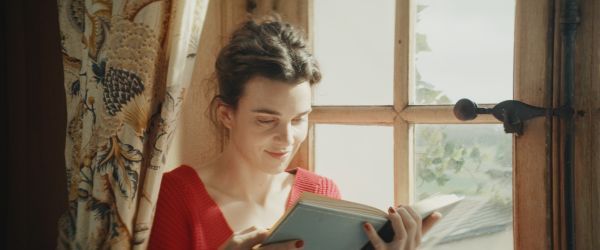
While not particularly groundbreaking or surprising, French writer-director Laura Piani’s film moves along at a pleasant pace as a mildly enjoyable ode to reading, writing, and the romantic comedy.
Agathe (Camille Rutherford) works in the rustically chic Shakespeare & Co. bookshop in Paris with her best friend, Felix (Pablo Pauly). Felix seems to possess all the lovable qualities of a potential partner—he’s good-looking, kind, and even babysits Agathe’s sister’s young son on occasion—but the chemistry isn’t quite there, and the two remain firmly in the friend zone. Perpetually single, Agathe is no fan of dating apps (who is, anyway?) or modern courtship rituals. She also dithers in a writing class, lacking both drive and confidence in her abilities.
One night, after dining in a Chinese restaurant, inspiration strikes. She writes a story, and Felix, without her knowledge, submits it to a Jane Austen residency in England. To her surprise, she’s accepted. Yet, instead of excitement, she feels reluctant to go—plagued by imposter syndrome and perhaps also daunted by the legacy of the residency’s namesake, whom she deeply admires.
With Felix’s insistent encouragement, she decides to attend. There, she meets Oliver (Charlie Anson), a distant relative of Austen. With his steely blue-green eyes and aloof demeanor, he’s the classic complicated intellectual. The two don’t quite click either; to Agathe’s initial annoyance, Oliver dismisses Austen’s literary qualities in favor of male authors. When the affable and unpretentious Felix shows up for a surprise visit, his warmth contrasts sharply with Oliver’s chilly elegance, raising that classic romantic comedy question: Who will the protagonist end up with? Fortunately, Piani steers the story in a slightly different direction for the finale.
Though set in contemporary times, Piani’s film boasts the visually pleasing, picturesque aesthetic of period dramas inspired by literary figures like Austen and E.M. Forster. Pierre Mazoyer’s rich cinematography—an impressive achievement for a feature-length debut—lingers lovingly over the buttery, dappled sunlight in the bookstore and the earthy green beauty of the residency’s idyllic estate.
At times, however, the film breaks the spell of its lush atmosphere with sudden dips into screwball comedy (two vomit scenes, a few pratfalls, and even spitting llamas), none of which is very funny nor meshes well with the story’s wistful tone. A scene in which a nude Agathe accidentally opens the wrong door and exposes herself is a groan-worthy, musty gag from decades and decades of sitcoms.
Rutherford—with her long face, lanky frame, and wavy brown hair, easily imagined as a heroine in a BBC Austen adaptation—does her best with this uneven material. She handles the physical comedy capably while also giving her character a melancholic edge, capturing Agathe’s fear, indecision, and emotional paralysis.
While the film often feels like it’s indulging in stale romcom tropes rather than subverting them, its ending brings a touch of gravitas via a Frederick Wiseman cameo. Agathe, who has long feared change and resisted progress (her name perhaps a play on “a gate”), finally ventures down a new “path,” a word that appears in a poem during the film’s hopeful, quietly touching final scene.






Leave A Comment