
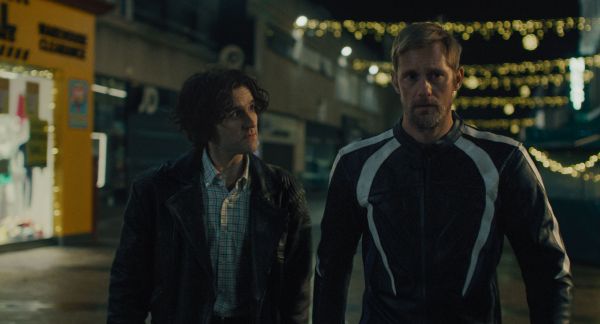
Notable recent BDSM-themed films such as Sanctuary and Babygirl are either relentlessly somber, chaste, or dryly coy. Yet, Harry Lighton’s bold and remarkably assured feature directorial debut plays out mostly like a fizzy—albeit sexually explicit—romantic comedy, with deep dramatic undertones.
Parking enforcement officer Colin (Harry Melling) lives with his lovely and supportive parents, Pete (Douglas Hodge) and his terminally ill mother, Peggy (Lesley Sharp, a hoot). After a Christmas Eve pub performance with his barbershop singing group, Colin meets biker Ray (Alexander Skarsgård) while ordering a drink. Without prompting, Ray (as though reading his mind) slips Colin his details and where to meet the next night, on Christmas. Given the older, tall, blond, muscular handsomeness of Ray, it’s no wonder why Colin—awkward, with sad eyes, crooked teeth, and a mop of scraggly dark hair—would be instantly enamored. A fumbling rendezvous in an alley (with some bootlicking) ensues. In short order, Ray invites Colin to his house in Chiswick, reveals his daily lists of demands (from grocery shopping to sleeping on the floor), and the two fall into a rigid sub/dom relationship.
Their relationship is mostly insular, but Colin, after shaving his head and donning a locked chain necklace, becomes initiated into Ray’s kinky biker circle. A group excursion to the woods, where Colin is intimidated by sub competition in Kevin (the Scissor Sisters’ Jake Shears, in his film debut), is one of the many highlights. At the same time, Colin’s parents are wondering, who is this cagey, aloof man Colin has been with for the past few months? (A disastrous dinner scene, where they attempt to get to know the taciturn Ray, still in control of Colin, is another standout.)
Lighton traces a newfound sexual awakening in Colin with comedy and occasional cinematic panache. The night scenes are moodily lit by cinematographer Nick Morris, while the daytime, especially within Ray’s house, is colder and flatter. The dynamite, symbolic opener, set to Betty Curtis’s “Chariot (I Will Follow Him),” is fixed mostly through the windows of Colin’s family car as Ray rides on his motorcycle past and in front of them, before their meeting at the pub. (Pillion: the passenger seat on the motorcycle.)
Pillion is often very funny because of its winning performances and edits (the reveals of stunning Ray to other characters, including Colin’s parents and coworkers, are quite humorous). While quietly composed, Skarsgård is doing tricky, believable work—sometimes a seemingly empty pain behind Ray’s eyes and an occasional inner wrestling feels tangible. He may be the dominant one of the pair, but Ray comes off as wholly subservient to his own fetish with some pretentious-seeming leanings, learning to play Erik Satie’s “Gymnopédie No. 1” on his keyboard and reading Karl Ove Knausgård’s My Struggle.
Despite his subservient role, Colin gains confidence—the aggravated drivers he gives tickets to are no longer intimidating. Melling plays his transformations plausibly, fluidly, and movingly. When Colin asks more out of Ray—a day off from the routine—the two are suddenly playing different notes (Skarsgård’s last shot is stunningly acted) as the film begins to question: How long-term is this couple?
Pillion is scheduled to be released in the U.S. in February 2026.





Leave A Comment