
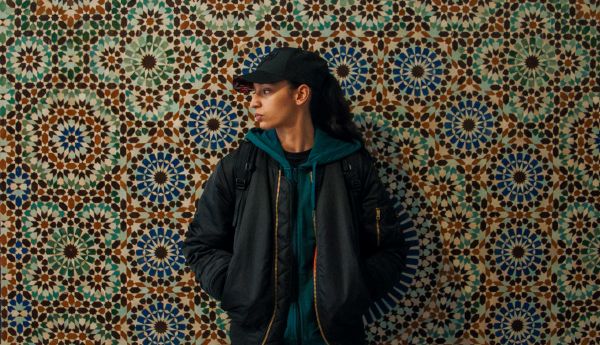
Two movies in 2026’s Rendez-Vous with French Cinema (presented by Film at Lincoln Center and Unifrance) offer close looks at the experiences of lesbians wrestling, internally and openly, with the expectations of patriarchal North African families. These young women, exposed to both French and Maghreb culture, also deal with the question of French identity, which looks as though it guarantees new freedoms but may extract concessions of its own. One film offers rugged emotion in engaging with the topic, while the other feels more delicate. Both have been critically rewarded. The Little Sister won the Prix Louis-Delluc and the Best Actress award at the Cannes Film Festival and has been nominated for six César Awards, while In a Whisper made its premiere at the high-profile Berlinale.
The Little Sister (La Petite Dernière)
Nineteen-year-old Fatima (Nadia Melliti) has a stern profile and a lean, sensitive face that hides feelings beneath a stoic front. Director Hafsia Herzi pulls a deep focus on her character, who first appears wearing a hijab and murmuring Islamic prayers in a poetic, slow-moving scene. But a few sequences later, Fatima methodically beats up a teenage boy at school—a measure of The Little Sister’s emotional range and deft changes in mood. Herzi’s film charts the girl’s sexual awakening and a whole lot more: branching out from a loving but limiting Algerian family in the Paris suburbs, her starting college days, and her entry into a competitive, sexually frank French society. Fatima’s journey is a moving, freewheeling story with positive energy to spare, revealing details that make its modest main character’s life feel real and worthy of attention.
Most gay people can recall their tentative first steps into queer life. There are gay people out there—how do I meet them? And how do I do it when I’m scared out of my wits? Fatima tends to be a bit of a scowler and a loner, so looking for dates does not come naturally. Fending off a traditional Muslim boyfriend and keeping a low profile among her parents and sisters, she strikes out on the net to connect with women under false identities. Her furtive (and funny) first date with a tough cookie is awkward for Fatima, and the second date is sensual but empty, yet both have a value of their own. Soon after, Fatima falls for an older nurse (Park Ji-min, from Return to Seoul). Their luminous, tender connection offers Fatima a freedom she has never known. And when the liaison collapses, Fatima needs to drum up the courage to advance into a new life. School friends, sexual experimentation, and—mais oui!—French philosophy await, if Fatima can take them.
The Little Sister sticks close to Fatima, and Melliti’s award-winning performance rewards the scrutiny as she brings the character’s dilemmas to a smoldering plateau. Herzi gives Fatima an array of challenging foils to bounce off of, including edgy bros, loudmouth lesbian libertines, and Fatima’s watchful and devoted mother. Scenes are fast-moving, and dialogue is natural. Little by little, you can see a teenager becoming a woman, a newly open and confident person, albeit with contradictory forces in her life that she will need to manage and reconcile. For now, the hard-won joy comes out on top—the best outcome for Fatima and for this heartfelt, affecting film.
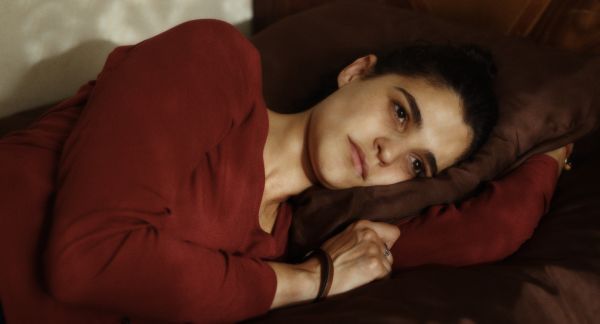
In a Whisper (À Voix Basse)
The leading character in Leyla Bouzid’s In a Whisper also faces a confining environment. It is arguably worse for thirtysomething Lilia (Eya Bouteraa), who has returned from Paris to Tunisia to a family that is bigger, more suspicious, and more vocal than Fatima’s. The occasion for the homecoming appears merely sad at first, then grows more sinister as details leak out; Lilia’s uncle has died, and his death looks like a hate crime that the family has difficulty facing or discussing. Meanwhile, Lilia has secretly installed her blonde French girlfriend in a nearby hotel, adding a layer of stress to an already fraught situation. She embarks on a citizen-detective quest to find out what happened to her relative while trying to stave off her family’s prying questions and keep her relationship under wraps.
Bouzid skillfully reveals the earth moving under Lilia’s feet. Her camera observes affectionate family dynamics in domestic scenes, then follows closely as the talk lurches from warmth to angry sniping. Tunisia itself feels like a sunny vacation spot one minute and a restrictive state the next, with homophobes spouting scorn and a nosy traffic cop soliciting bribes. Lilia is uncertain whether to introduce her family to her lover, who does not understand the need for discretion in a conservative society.
This is a tense spot for a lead character to inhabit, but the movie’s laid-back pacing at times squanders the tension. The camera too often focuses on Lilia fretting into the middle distance. Dropping and picking up the investigation into the uncle’s death diminishes some of the quest’s urgency, although homophobia and fear are amply exposed. Lilia and her girlfriend are in love, but we do not know much about their relationship. Luckily, a full house of actresses, including Palestinian standout Hiam Abbass, adds texture and warmth to numerous charged interactions, and Lilia’s confrontation with an authority figure brings some grit and backbone to the narrative.
Like The Little Sister, In a Whisper leaves us with a note of hope and a feeling of goodwill toward a film that, despite its soft touch, handles difficult issues with care and sensitivity.
The Little Sister will be distributed by Strand Releasing in the spring. The distributor will also release In a Whisper in the United States.





Leave A Comment