
Who says there are no more roles for women over the age of 70? Two slyly spry films seeking audiences and worldwide distribution at the Toronto International Film Festival prove any doubters wrong. Both provide a showcase for their veteran actresses.
Brazilian director Gabriel Mascaro, who made a splash with his audacious and sensuous Neon Bull in 2015, presents his latest, The Blue Trail (O último azul), the 2025 winner of the Berlin International Film Festival’s Silver Bear Grand Jury Prize and a highlight of this year’s TIFF. Mascaro successfully mixes genres that don’t always blend well. Part dystopian nightmare, sci-fi, kitchen-sink drama, adventure tale, and satire, with a hint of romance, the film remains focused despite its shifts in tone. The storyline stays on track, much like its stubbornly determined curmudgeonly protagonist.
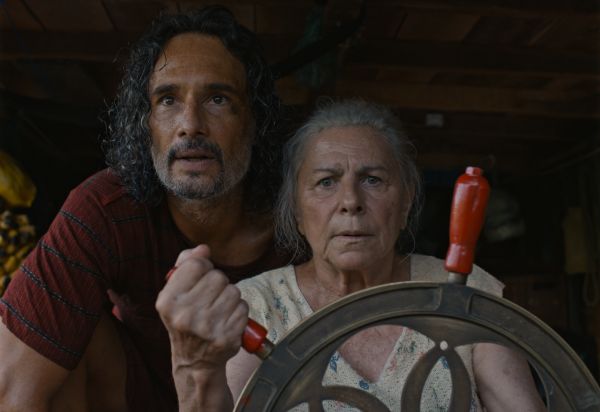
The film opens in contemporary Brazil, where the government’s slogan “The Future Is for All” is belied by its actions. Everyone past the age of 75 must report for departure to the mysterious “Colony” to live out their final years; no one has yet ever returned. After working a shift at an alligator abattoir, Tereza (Denise Weinberg) returns home to find wooden laurels on her doorway and receives a medal from a patronizing government worker for being a “national living heritage.”
At 75, her days are numbered at work and at home. Before she is taken away on what she derisively calls “the wrinkle wagon,” she wants to travel on an airplane for the first time. However, she faces red tape: Her daughter, who receives a monthly stipend as Tereza’s official sponsor/guardian, needs to grant permission for a ticket. To keep the money coming, the daughter cooperates with all government regulations.
When Tereza takes matters into her own hands, the film shifts from dystopian tale into a ramshackle river trip and escape movie. The aspect ratio expands as Tereza’s adventure grows in scale, evoking an epic feel, as she drifts into the country’s interior, in large part to cinematographer Guillermo Garza’s John Ford–like skyscapes. Viewers may be reminded of The African Queen when Tereza boards a boat with a crusty, world-weary captain (Rodrigo Santoro) who has a broken heart. He introduces her to his private bliss: the “blue drool snail.” A few drops of its ink in one’s eye induces a psychedelic trip, like ecstasy times 10.
After disembarking and still seeking air travel, our heroine takes a kind stranger’s advice and buys a cap to hide her flowing white hair. Another passerby suggests hiding in an abandoned amusement park. Tereza, who has mostly encountered men until the film’s second half, meets Roberta (Miriam Socarrás), a self-described nun roughly her age. Roberta sells digital Bibles (another satirical touch) from her barge and offers a practical tip: one can buy an exemption from the Colony. The two become sisters of the traveling riverboat. Despite Tereza and her worldly sidekick’s cynicism toward authority, the film itself avoids succumbing to skepticism, suggesting that you are never too old to undergo a rite of passage.

In Moroccan director Maryam Touzani’s spiky and sentimental Calle Málaga, nearly 80-year-old actress Carmen Maura stars in Touzani’s first film shot in her hometown of Tangiers. For 40 years, Tangiers-born María Ángeles (Maura, still possessing the mischievous gleam from her decades with Pedro Almodóvar) has lived in a cozy apartment above the narrow, eponymous street, where everyone knows everyone else’s business. One morning, she buys ingredients to make a tortilla for the arrival of her adult daughter, Clara (the stern Marta Etura), a divorced nurse living in Madrid. Upon arrival, Clara, despite not having seen her mother in two years, remains taciturn during the mother-and-daughter paseo through the neighborhood. After dinner, Clara gets down to business and reveals the reason for her return: She has put her mother’s apartment, which Clara’s father left to her, on the market. With two kids and a €1700 monthly salary, she sees this as a financial breakthrough.
However, Clara made the decision without consulting her mother. Stunned and betrayed, María Ángeles refuses to give up her home. But she eventually gives in to her daughter’s pleading and, perhaps, the idea of the sacrificial mother. She agrees to sell her furniture, clear out, and move into an assisted living facility. This sacrifice proves to be temporary. Like Tereza, María Ángeles makes her own escape plans and plots to reclaim her home—though she would likely reject being described as “feisty.” (Some of María Ángeles’s adventures echo recent news about the three Austrian nuns who were kicked out of their convent and found a way to return home.)
To buy back her belongings bit by bit from antique dealer Abslam (Ahmed Boulane), María Ángeles starts a side hustle, converting her living room into an all-you-can-eat-and-drink soccer-watching venue for her soccer-crazed neighbors, much to the chagrin of a local cafe owner. At first, she views Abslam as a by-the-book co-conspirator with her daughter (he isn’t; he’s just doing his job). Rather than remain an irritant, he becomes a sleuth, helping her track down a missing heirloom. As she sheds her hostility toward Abslam, so does she shed her clothes after a romantic dinner.
The tone occasionally turns sitcom-y when María Ángeles confides in her lifelong friend, Sister Josefa (scene-stealer María Alfonsa Rosso). Though the nun is under a vow of silence, Sister Josefa’s raised eyebrows and widened eyes speak volumes as María Ángeles recounts her sex-filled evening with Abslam. Lest this tale of a late bloomer sounds precious, the director handles the romance respectfully, with no winks or nods. There are no Grumpy Old Men here.
The Blue Trail currently does not have U.S. distribution. Calle Málaga will be released by Strand Releasing and will represent Morocco for this year’s international film Oscar.









Leave A Comment