Seven years ago, Once Upon a Time… in Hollywood was released, the film that Quentin Tarantino himself would come to consider the best of his career—a statement that isn’t particularly controversial. An exceptional film, indeed, in which the American director, without renouncing his trademark violence and irreverence, seemed to reach the pinnacle of his artistic maturity, creating the ultimate elegy to Los Angeles, Hollywood, and the history of an industry at a turning point. Tarantino has remained steadfast in his decision not to make another movie since then, insisting that his next one must be his “last movie.” Well, he’s not exactly back now, but almost. With a little help from David Fincher (no less), Tarantino revisits the universe of his previous film with a sequel, or rather a companion piece, deliberately conceived on a smaller scale, written by him, though not directed by him.
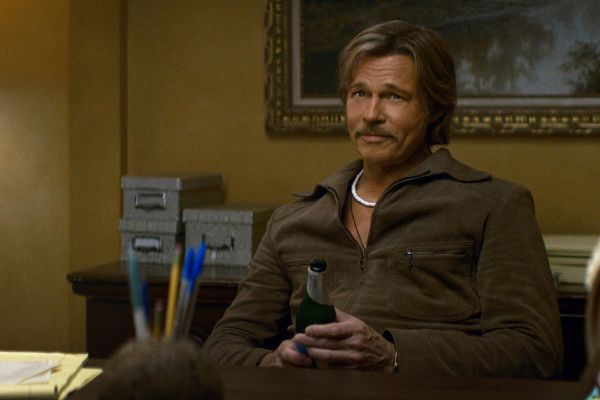
The Further Mis-Adventures of Cliff Booth picks up eight years after the events of its predecessor, but this time it’s exclusively centered on Cliff (Brad Pitt), the former stunt double and unwavering friend of movie and TV star Rick Dalton, who, we’re told, has put on weight and is now starring in a television series in Australia. (Don’t even expect a Leonardo DiCaprio cameo.) Yet the distinctions from the first movie are notable beyond the promotion of Booth from sidekick to leading man, now a little more wasted and scarred than before. Its distinctive celluloid cinematography has been entirely replaced by digital photography, courtesy of Erik Messerschmidt, and the helmer this time is the methodical, cool-headed Fincher, a great director in his own right who nevertheless couldn’t be more opposite to the effervescent, voluptuous Tarantino. The vital and contradictory tensions make it an even more fascinating experiment.
It’s the summer of 1977, and in sun-drenched Los Angeles, Hollywood still feels like the center of its peculiar microcosm. Star Wars is the movie of the moment, but it seems that avoiding the massacre orchestrated by Charles Manson in Once Upon a Time… in Hollywood hasn’t entirely rewritten history after all. Cliff Booth now navigates a city that feels more dangerous and unsafe, coinciding with a world in which the counterculture has, in any case, won and settled in for good, even as new changes loom on the horizon. (New Hollywood is about to be pushed aside by the blockbuster monoculture.) Limping and sporting an unruly look complemented by a mustache, Booth is a jack-of-all-trades who sometimes works as a projectionist at the New Beverly Cinema, where blaxploitation movies are part of the regular programming, or as a bartender at a tiki bar where women take part in mud-wrestling matches. All of this is symptomatic of the fact that it’s no longer 1969. Practically retired as a stuntman, Cliff is preceded by the public reputation of the things people know about him (he defeated Bruce Lee in a fight; he killed those hippies who mistakenly invaded Dalton’s house), but above all, in private, he’s known among Hollywood insiders as a fixer: the man you call when a difficult situation needs to be handled.
As the title suggests, Tarantino’s screenplay is structured around a series of loosely connected situations that seem to unfold in a freewheeling spiral. Fincher, for his part, approaches this more cynical and darker universe, very much in his lane, with plenty of opportunities for set pieces that balance the chilling precision of his touch with his collaborator’s dark humor, while allowing the meandering nature of the journey to flourish through witty Tarantino dialogue (we’re here for that, after all).
So, the massacre of a family at an isolated private residence on a Hollywood hillside serves as an early, direct counterpoint to the fairy-tale ending of the previous film, in which Sharon Tate’s murder was prevented. Meanwhile, Booth’s recovery of stolen belongings from a closeted gay filmmaker (including an Oscar for Best Director) ends with some blood being spilled. This heart-racing confrontation establishes the essential point: Terrible things happen constantly in Tinseltown, and many more will follow.
If there’s a defined plot, it involves Cliff Booth being recruited by TV star Charlie Peters (a scene-stealing Scott Caan) to prevent a hit against his wife, Toni (Carla Gugino), carried out by two Filipino thugs whom he got drunk and hired to kill her, only to change his mind after a passionate reconciliation. Booth probably wouldn’t help him were it not for his own history with Toni and because doing so will bring him even closer to Karen Crosby (Elizabeth Debicki), the actor’s agent. And knowing Fincher and Tarantino well enough, you can expect a big, violent climax that will have you holding your breath.
In the meantime, the best moments here are its stops and detours: Cliff sharing sweet moments with his father, Gus (Peter Weller), as they watch old movies on television; the sexy banter with Karen, which packs a figurative and literal slap (you’ll see!); and those very Tarantino-esque sequences, such as a showreel of Charlie’s career or a scathing monologue questioning the status of movies as art and taking a jab at film criticism, reducing it to finding the difference between a Big Mac and a Whopper.
In any case, The Further Mis-Adventures of Cliff Booth is meaty entertainment, sure, but also a full-fledged reminder of why we love movies (whether artistic or not) in the first place, and why we keep returning to them. Graced by Pitt’s effortless charm, Fincher and Tarantino join forces on the most relaxed project of their respective careers: an embittered defense of Hollywood, distilled into what the movie industry can still offer: pure, undiluted pleasure.

Leave A Comment