
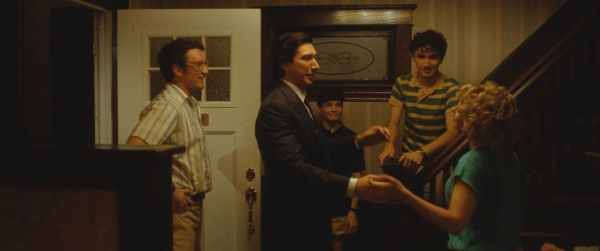
As lifestyles go, Irwin Pearl (Miles Teller) and his brother Gary (Adam Driver) occupy wildly different worlds. Irwin became a successful engineer with a wife and kids, while Gary became a mostly respected New York City cop, though with dubious connections. Irwin’s day-to-day life and attire are distinctly blue-collar. Now retired, Gary regularly dresses in tailored suits, carries a gun under his pants leg, and can sweet-talk his way out of most dicey situations. Irwin can afford a house in 1980s Queens, but Gary can afford to treat Irwin’s entire family to dinner from the pricey Peter Luger Steak House.
What transcends the class differences is a genuine, if complicated, love that forms the backbone of Paper Tiger, James Gray’s (The Lost City of Z) newest noir-thriller about family and opportunities far too good to be true. It’s through this opportunity that new criminals begin to mark their territory within New York City’s underground, leaving an ordinary family in unexpected peril. Not every storyline here is intertwined to the fullest, but its combination of strong performances and atmospheric cinematography are more than enough to rebalance the scales.
Irwin isn’t unaware of Gary’s side hustles, and he has his wife, Hester (Scarlett Johansson), and sons Scott (Gavin Goudey) and Benjamin (Roman Engel) to think about, especially with Scott about to head off to college. Yet Gary sees a business deal in the works as plans to renovate Brooklyn’s polluted Gowanus Canal take shape—the kind that requires an engineer to oversee regulations. In his eyes, the traditional mafia are on their way out and, so long as the brothers maintain positive relationships with the new Russian immigrants moving in, everyone wins. Such a consulting business could even earn Irwin more than enough cash to support his family, so long as one doesn’t question where all that canal waste is going.
Unfortunately, both brothers underestimate the lengths these new mobsters are willing to go to make a point. When Irwin stumbles upon the Russians doing something clearly illegal, his attempts to play supervisor result in a beatdown, the kids getting threatened, and a massive debt placed over the entire family’s heads. Gary immediately vows to settle this debt, but the situation proves to be an immovable threat unfazed by his charm or contacts. For once, Gary doesn’t hold all the cards, and Irwin clearly cannot tolerate his family having a target on their back. Factor in Hester exhibiting symptoms of a severe medical diagnosis, and this conundrum quickly threatens to weigh everyone down unless sacrifices are made.
Paper Tiger‘s setting might be 1986, but Gray renders its aesthetic with a clear love of classic 1970s New York cinema. There’s an urban grit to these locales reminiscent of Taxi Driver and The French Connection, revealing a criminal underbelly living side by side with middle-class suburbia that won’t abide by old rules. At one point, Irwin discovers that the criminals are spying on his family: The comforts of home are no longer safe. However light on action, Paper Tiger delivers an eerie tension that tightens its grip as the story progresses, tied in large part to a family bond that prides itself on loyalty to a fault.
What keeps the story from becoming airtight is how often its main and secondary plots feel separate from one another. Hester’s mini-arc of grappling with her health is well-acted and heartbreaking but, despite eventually looping into the drama, acts too independently of Irwin and Gary’s dilemma. It simply becomes one domestic problem playing second fiddle to a far more abnormal conflict that can’t be solved by consulting the usual authorities—something Gary learns the hard way upon discovering his former status within the police force no longer holds the sway it once did to keep his brother and family safe.
As good as Teller and Johansson are, Driver really is the main reason to see this film. From the moment he stops by, it’s easy to see why Irwin’s sons would view Gary as the cool uncle and how, up to a point, the audience might trust him to safely handle disputes. Driver plays Gary as a man at once naturally confident and in over his head, his superpower gradually fading as the size of the threat backs Gary into a corner no matter how sincere his intentions. It’s a mesmerizing performance that, paired against Teller’s everyman demeanor, makes for a fittingly tragic character torn between love and easy money.
For Gray, it’s clear this particular iteration of New York is familiar to him in an autobiographical sense, constantly revisiting the grimy Queens/Brooklyn backdrop in past projects from Little Odessa to Armageddon Time. Paper Tiger reveals how the financial ambition of this era drives both its domestic and criminal worlds, with the intertwining of the two proving as toxic as canal water back in the day.










Leave A Comment