
It’s been seven years since the last collaboration of the Coen brothers (2018’s The Ballad of Buster Scruggs), which makes it impossible not to miss one of the most iconic and prolific filmmaking duos ever. Luckily, this hiatus has not turned into a pause or retirement, as each has focused his talents on solo projects. At the same time, their separation has revealed the divergent visions and aesthetic pursuits of each brother, and how much their individual works differ from their collaborations. Joel Coen’s The Tragedy of Macbeth (2021) is a severe Shakespeare adaptation, elevated by its minimalist black-and-white cinematography—more arthouse than anything else in their shared filmography. By contrast, Drive-Away Dolls (2024) is a silly comedy with elements of a crime caper and bursts of violence, closer to the Coen signature but a minor version in ambition and dramaturgy. A similar judgment can be made of Honey Don’t!, Ethan Coen’s follow-up and second solo outing, again co-written with Tricia Cooke.
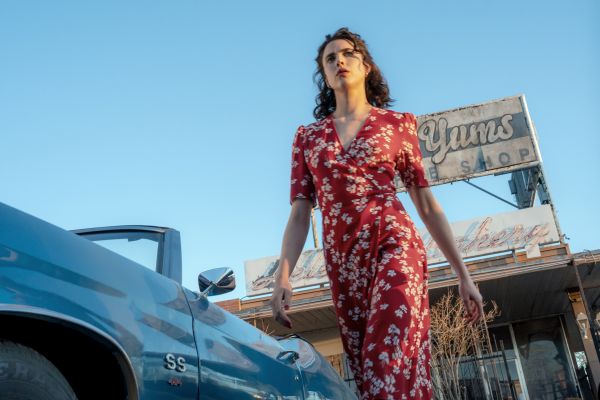
Drive-Away Dolls and Honey Don’t! clearly share the same spirit, marked by narrative looseness and a playful emphasis on sex and violence. The first was a road movie about lesbians on the run; the second stays within the boundaries of a neo-noir, a stiff detective story that never leaves its Californian setting of Bakersfield. Once again starring Margaret Qualley, this time as private investigator Honey O’Donahue, the film introduces a character whose high-heel click-clack announces her presence wherever she goes. A recovering alcoholic, a womanizer, and the boss of a detective office with her own secretary, Honey feels both anachronistic and timeless, a character that could only exist in the movies. The world around her—with Christian cults guarding secrets, traffic accidents that might be disguised homicides, and a desert climate that exudes hostility and boredom—also seems to come from another era. That’s why it’s a surprise when mentions of Covid, a MAGA bumper sticker, or Honey’s refusal to use smartphones remind us that the story is, in fact, contemporary.
Whatever can be called a narrative thread here is intentionally vague and often laughable. A series of murders that may or may not be connected drags Honey into an investigation that doesn’t really lead anywhere. Still, she develops a curiosity about a case involving an almost-client who died right after calling her, before he managed to hire her. That mystery gives her enough excuses to drive back and forth, flirt with the sexy police officer MG Falcone (Aubrey Plaza), rub shoulders with other detectives such as the delusional Marty Metakawich (Charlie Day), and tie together just enough loose ends to maybe connect the deaths to Rev. Drew Devlin (Chris Evans), whose ministry shows signs of being a front for illicit businesses. Eventually, new murders and the inexplicable disappearance of her teenage niece Corinne (Talia Ryder) force Honey into more dangerous, darker terrain—or at least as much as it can be in a movie that never takes itself too seriously.
Honey Don’t! has its fair share of fun and sexy moments that capitalize on the cast’s appeal. Evans, for instance, takes the chance to play a creep who’s as despicable as he is charming, and he hasn’t bared this much skin (a jockstrap counts, barely) since his Hollywood hunk era of the early 2000s. Qualley and Plaza, meanwhile, have good chemistry, so their inevitable pairing doesn’t disappoint—until a bizarre twist reveals other fates for their characters. There are also a few uniquely seductive Coen images: a pair of coffee mugs, the sun’s reflection on sunglasses, a woman riding a motorcycle, or a shadow seen through the eyes of a corpse. These are captivating visual riddles that make us feel like accomplices to crimes and mysteries. But this is not a Coen brothers movie, so any crime or mystery we imagine is inevitably more disturbing than the one we actually get.
To be honest, Honey Don’t! is barely a coherent or watchable film, and for something made by either half of the Coen brothers, it often feels like the surname is doing the heavy lifting. You’ll have to pretend there are more reasons to give it your time than you would for an unknown filmmaker presenting similar work. Although everyone involved was clearly having fun, that enjoyment doesn’t fully translate to the screen. As an audience, you end up adrift, wandering through an artifice full of lust and danger, without the focus or purpose needed to keep you engaged.



Leave A Comment