
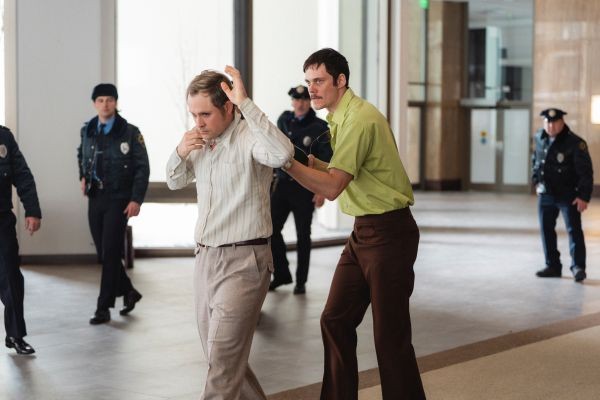
Gus Van Sant is no stranger to the antihero, whether it’s the drug addict pharmacist thieves of Drugstore Cowboy or the hustlers of My Own Private Idaho. In his latest, based upon a true, oddball, American local news yarn previously lost to history, Van Sant focuses upon Tony Kiritsis (Bill Skarsgård), an Indianapolis man who, in February 1977, abducted mortgage broker Richard Hall (Dacre Montgomery) and held him hostage for roughly two-and-a-half days by wiring a shotgun to his head.
Kiritsis had fallen behind in payments for a property he planned to develop and became convinced that Hall’s company was in cahoots to seize the valuable land, after they refused to grant him leniency on his overdue payments. When Hall is taken, his father, also the head of the mortgage company (Al Pacino), is surprisingly apathetic. Away on a trip to Florida, he is bullish and doesn’t heed Tony’s demands for hostage money and an apology, prolonging the standoff. He seems to think, maybe, this will all blow over. Instead, Kiritsis wants to make the fraudulence of the company known, sending his statements of his misgivings of the bank and demands to his beloved, charismatic local DJ, Fred Temple (Colman Domingo), to read on-air. He later stages a tense, televised press conference, demanding an apology and compensation.
Shot in Louisville, Kentucky, in a frigid, wintry setting, this film relays real-life events, but also makes its sense of artifice known. Pacino delivers a silly, devilishly hammy performance, complete with a puffy Southern drawl. His casting could be intentional, a reminder of the far more electric, yet similarly themed hostage drama, Dog Day Afternoon.
Skarsgård, known for his shapeshifting monster roles in Nosferatu and the “It” movies, plays a more grounded, ordinary figure here. There’s a push and pull throughout, where I felt sympathy, misgivings, and pity for Kiritsis. All those complicated emotions are evoked in Skarsgård’s turn. His put-upon Midwest accent and terse vocal inflections are slightly off, though, or perhaps just too obvious. There were times he lacked authenticity because of the showiness of his portrayal, though this performative quality may be intentional: Kiritsis is giving a performance himself as an avenger through his own staged spectacle.
Throughout, the film cuts between real news footage of the 1977 incident and the filmic ones. A subplot involving an ambitious news reporter, Linda Page (Myha’la), ends up feeling unconvincing because the movie leans so heavily on actual reportage. Van Sant used a similar technique more successfully in Milk, where the blending of real and fictionalized footage felt more seamless, especially the scenes of a candlelight vigil.
When the real Kiritsis and the hostage press conference are shown in archival footage during the end credits, it’s particularly jarring, as he bears no resemblance to Skarsgård at all, including the way he talks, and, admittedly, he is not nearly as handsome either. Is Van Sant making a Bonnie and Clyde–style statement upon the glamorization of violence in film? The clash of the real with the fictionalized made me look back at the film with a deeper sense of ambiguity. This happened, too, in Derek Cianfrance’s Roofman, where the end credits lavished attention on the “real” antihero protagonist.
Nevertheless, in one of the more striking moments, while Kiritsis has Hall holed up in his apartment, the film includes the televised broadcast of the 1977 People’s Choice Awards, where John Wayne is presented with a Favorite Motion Picture Actor award, accompanied by a montage highlighting his Westerns. It’s interrupted by a special news report of Kiritsis’s own outlaw story. Even if the film is a bit muddled and a bit on-the-nose, with subplots that aren’t as riveting, this story could be akin to a modern Western—the story of a little guy against the system, which remains pertinent, especially as America’s economic gap deepens.



Leave A Comment