A fanciful oddity, Alex Huston Fischer and Eleanor Wilson’s film works best when leaning into some of its horror influences and darker elements rather than its propensity for broad comedy.
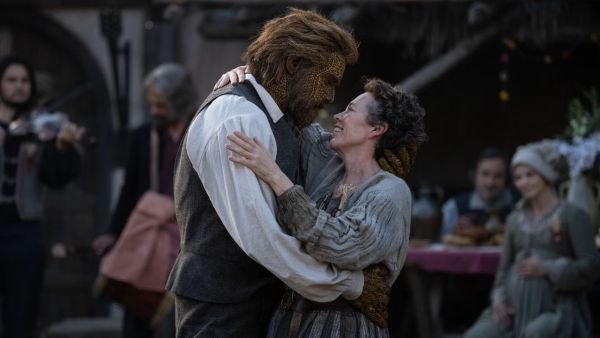
Based upon a short story by Ursula Wills-Jones, the fable-like tale takes place in a primitive village during an unspecified time in what appears to be the medieval era. A spinster with an unkept look, wearing billowing, fishy-smelling, dirt-streaked dresses and sporting a unibrow, the Fisherwoman (Olivia Colman, in yet another sterling performance) is a social outcast, but still valued for her skill at providing food for the village, especially by the similarly outcast Basket Weaver (Peter Dinklage). He is ostracized because of his height and appearance. After a town wedding ceremony, during which a ritual similar to the catching of a bouquet takes place, the Fisherwoman is the lucky one who cracks open a basket-woven egg to reveal a burst of a particular color (a joke perhaps on gender-reveal parties), meaning she will be the next to marry. Out of sympathy, knowing she has few marital prospects, the Basket Weaver makes her the perfect, nurturing husband (Alexander Skarsgård), made from wicker.
As he did in Pillion, Skarsgård once again plays an object of desire who unlocks another’s sexual awakening. Here, the Fisherwoman is thoroughly aroused and satisfied by the Wicker Husband’s wicker goods. More compelling than the initial joy of their relationship is its eventual wearing down (wicker itself isn’t invincible, either). The superstition-laden townspeople’s reaction to this unlikely pair is what makes the film interesting, including jealousy from the prim, proper, and relentlessly passive-aggressive Tailor’s Wife (Elizabeth Debicki), who is also the daughter of the village’s doctor (Richard E. Grant, in a too-brief appearance).
There are a lot of obvious, cheeky, bawdy moments that wear thin after a while—the film’s mileage depends on how funny one finds it all. Wicker feels stronger when it leans more into its unsettling gothic elements. A low-to-the-ground, fast-moving camera angle hurtling toward the Fisherwoman’s cabin door is reminiscent of Sam Raimi’s The Evil Dead. One could also imagine Vincent Price, in the mode of Roger Corman’s Poe adaptations, in the role of Dinklage’s Basket Weaver, with his lengthy, almost mustache-twirling philosophical monologues as he prepares his woven, supernatural creations.
There are modern-day implications to mull over as well, despite its taking place in the 1600s. The story itself is also reminiscent, in a way, of The Stepford Wives or Drew Hancock’s modern-day robot comedy-horror film Companion, in which an artificially intelligent being provides seemingly unending sexual and emotional gratification.
Colman is once again lively and mesmerizing, ranging between wily glee, anger, and devastated hurt. Skarsgård has the most difficult role, though: He is robotic and monotone, yet his piercing blue eyes somehow manage to convey emotion beneath the marvelous practical makeup effects. The willowy Debicki is a solid presence, her character’s rampant seriousness a welcome counterpoint to the whimsy that is often given too heavy a pour. The tailor’s wife starts out as a one-note villain, but there are layers to Debicki’s performance that suggest something more complicated and quietly sinister.
Lol Crawley’s handsome cinematography is slicker and sunnier than his Oscar-winning work on The Brutalist, yet it also has some of that film’s grain and foreboding look. (There’s a wonderful early shot of Colman’s visage in a bucket of water that sets the tone and becomes a symbolic motif again later.)
While the script is sometimes weak, with a few overcooked comic beats that could have been cut, the result is still one of the year’s most offbeat offerings, enhanced by its strong ensemble and craftsmanship.








Leave A Comment