
Corrosive and freewheeling, Lynne Ramsay’s latest film often feels as if it’s spinning out of control, with no end in sight. Jennifer Lawrence’s electric performance anchors the film, keeping it consistently captivating—though “anchors” might not be the right word, since her character is so perpetually rudderless.
Based on Die, My Love, a 2012 novel by Ariana Harwicz about a woman with a mental health illness in rural France, Ramsay relocates the story to remote Montana. Grace (Lawrence) and Jackson (Robert Pattinson) move from New York City into Jackson’s uncle’s old house to be closer to Jackson’s mother, Pam (Sissy Spacek), and ailing father, Harry (Nick Nolte).
The opening wide shot of the house’s interior, basking in sunlight, is evocative and sets a tone that lingers over the rest of the film. The home is a rustic, abandoned fixer-upper with floors littered with leaves and walls papered in mismatched floral designs. The move is seemingly a promising fresh start for this couple—a place where Grace can write a novel and Jackson can make music. Yet, the movie begins almost like a haunted house movie, as we learn that Jackson’s uncle shot himself there. The camera angles often feel sinister (the exceptional photography is by Seamus McGarvey), as if they are coming from the point of view of a spirit watching them, creating a sense of foreboding.
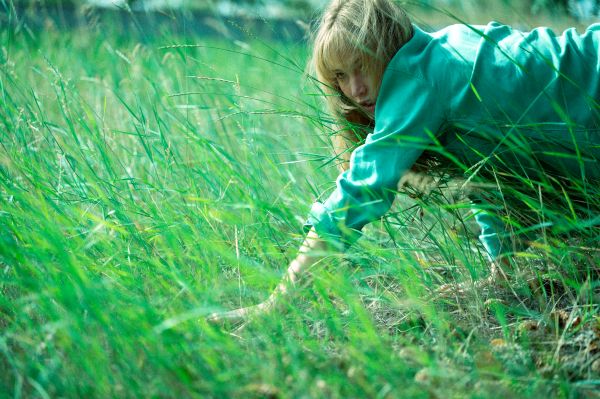
At first, there’s a breezy, playful silliness between Grace and Jackson. They joke and cavort—Budweiser-buzzed—crawling like tigers through tall grass. Then Grace becomes pregnant, a child is born, and tiny fissures start to appear between the couple and within Grace’s psyche. She leaves a chef’s knife near the baby, lashes out at a relentlessly, chipper gas station cashier, and grows increasingly isolated taking care of the baby while Jackson is away. (It’s inferred he’s off sleeping around, though it’s unclear what he does for work.) One night, he’s rapt with wonder as he looks through a telescope at the stars, while Grace feels as if the universe makes her feel like “nothing.”
The rest of the slender storyline tracks the unraveling and erratic behavior of Grace’s deteriorating mental state. It’s a brutal journey, with nary a glimmer of hope or redemption. The film is designed to have the viewer experience Grace’s misery and isolation with her rather than as merely an agog spectator. (This also happens in this year’s similarly oppressive Mary Bronstein film, If I Had Legs I’d Kick You). Vivid sound design heightens this: the drip of breast milk and ink over a blank sheet of paper (a striking symbol of art and motherhood), flies buzzing about Pam’s house, and the incessant whining and barking of a dog that Grace hates. (This pet becomes one of the first big divisions between the couple.) In one of the most wrenching moments, Grace destroys the upstairs bathroom, scratching wallpaper until her fingertips bleed.
However, these emotionally violent swings are peppered with elements of comedy. Lawrence has always been a natural screen presence, seemingly at ease with a wry, caustic humor. Throughout, a viewer is continuously surprised by every line reading, emotion rendered, and jokey muggings (Grace barking back ferociously in the face of the dog). In those respects, it is reminiscent of Gena Rowlands in John Cassavetes’s A Woman Under the Influence. Sometimes, the raw, loose emotions and dark humor of Cassavetes’s movies seem to be in conversation with this film.
Unexpectedly, Bambi is alluded to. A song from its soundtrack, “Little April Showers,” plays during one of the many lonely walks Grace and the baby take through the woods. Perhaps not so coincidentally, both films feature shotguns, forest fires, and the threat of a mother’s death. The special effects of fire in Die, My Love have an almost painterly, animated effect.
Besides the Bambi tune, other quirky, childish songs appear throughout the soundtrack, usually playing on the couple’s record player, adding to the sense of irony and looniness (“The Chipmunks’ version of “Let’s Twist Again,” Toni Basil’s “Mickey,” and Raffi’s “Apples and Bananas”). The film’s end credits feature a stark version of “Love Will Tear Us Apart” by Joy Division, a band whose lead singer, Ian Curtis, battled depression. The cover is performed by Ramsay herself.
With her testy, unbridled performance, Lawrence fully carries the picture. In a supporting turn, Spacek is also excellent as Grace’s mother-in-law. After Harry’s death, Pam still irons his shirts and sleeps on the couch with his shotgun. She sleepwalks with it at dawn, treading down a dirt road, and laughing up at the sky. Maybe, in her grief, she’s going a little mad too. The interactions between Spacek and Lawrence are easily the strongest, as both play characters that feel authentic, in desperate need of connection, who can’t quite connect, constantly dancing on the edge.
Unfortunately, the wonderful LaKeith Stanfield is underutilized as a mysterious neighbor. He could be a mirage of Grace’s sexual desire, riding his motorcycle on the skirts of her and Jackson’s property. The two meet up a few times, but it’s sometimes ambiguous if Grace is experiencing certain events or dreaming them up. Overall, Stanfield’s presence is wrapped in an ineffectual side narrative.
Pattinson, meanwhile, is no match for Lawrence as an actor. In one moment, he sulks about pearly, moonlit grass in a cowboy hat, looking as if he’s in one of his Dior ads. Perhaps his casting is intentional—he fully embodies someone who is distant, blank-eyed, removed, and woefully unable to deal with the hurricane force of Grace.
Though Ramsay wants you to experience Grace’s unending misery, the journey does go on too long, with several points that could have been potential endings. The ultimate final moments are a bit of a letdown, especially for a film less interested in putting an exclamation point on the ends of scenes and more in creating a suspended sense of unnerving mystery. It’s only two hours, but the harrowing journey seems more like three. Still, it’s impossible not to want to ruminate over it, especially because of the haunting lead performance.



Leave A Comment