
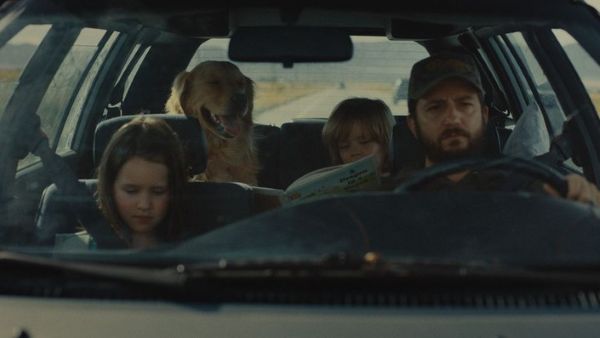
Like its mostly internal protagonist played by John Magaro, director Cole Webley’s quietly powerful debut often keeps the audience at bay. The film is set in the American West in 2008, at the height of the financial and housing crisis, but it offers scant details of its period—a McCain for president sign is glimpsed in the opening, hanging in the dirty window of a hardscrabble house. Although there are a couple of dramatic, emotionally devastating moments, the film otherwise doesn’t take big swings, nor does it rely on many plot points or twists.
Magaro plays a nameless dad of two young children, Ella (Molly Belle Wright) and Charlie (Wyatt Solis), who, along with their sunnily grinning golden retriever, embark on a road trip from Utah to Omaha, Nebraska, on the morning of the foreclosure of their modest home. (On the title card, the “O” of Omaha includes a drawn smiley face.) As a sheriff officer waits outside to lock the house up, they all take a few things—Ella hurriedly grabs a pile of books (the era-appropriate Twilight among them) and a photo of her late mom, who passed away recently from an unrevealed illness. The car is low on gas and has trouble starting, so dad and Ella, from the open doors of the driver and passenger sides, push it down the road.
The script by Robert Machoian (The Killing of Two Lovers) offers just a few details of the family’s predicament and no apparent reason why Omaha is their destination. The dad is barely able to afford gas and food for the kids. (The joke of Charlie complaining, “I’m hungry,” and the dad saying back, “Oh, you’re hungry. Nice to meet you,” feels sadly familiar to them.) Yet he splurges on a $4.99 gas station kite that the kids play with in the open air of the salt flats. When Ella slides in her mother’s CD, “Mony Mony” blares, and the kids dance emphatically in their seats—perhaps a glimmer of happier times when she was alive.
The script’s use of point of view is ultimately one of Omaha’s most emotionally resonant aspects. Often the film is told from Ella’s perspective, though sometimes it switches back to the dad, keeping us somewhat unsettled and unsure where their stories are headed. Paul Meyers’s cinematography effectively captures the feeling of these perspectives as well, especially when shot from the lower angles of Ella’s point of view.
Overall, Webley’s filmmaking isn’t distinctive or flashy, but the direction of his actors reveals a particular skill and tenderness. A longtime character actor, perhaps most familiar to some as a presence in Kelly Reichardt’s films, Magaro delivers a subtle, wonderful performance. (Omaha echoes Reichardt’s patient pacing and wandering, American West character-driven storylines.) Even though the walls are closing in on him, his family man is often set against blue skies and vast landscapes. He mostly keeps everything pent up inside, with a pinched expression of desperation that sometimes, agonizingly, breaks, shaking with tears. Child performances are always risky, but thankfully both Wright and Solis exude affecting naturalism. Wright has to navigate a lot of varying emotions, including some harrowing moments, and she handles it all gracefully.
On paper, Omaha may seem like a Western-set, stereotypical “Sundance movie” (it premiered there in 2025) of the kind occasionally derided by critics. But Webley’s film delves into the economic and emotional pains of a particular family with specificity and without mawkishness. It’s an unassuming yet memorable debut feature, and one that lingers, especially when thinking about the continuing stark economic divisions within American society.



Leave A Comment