
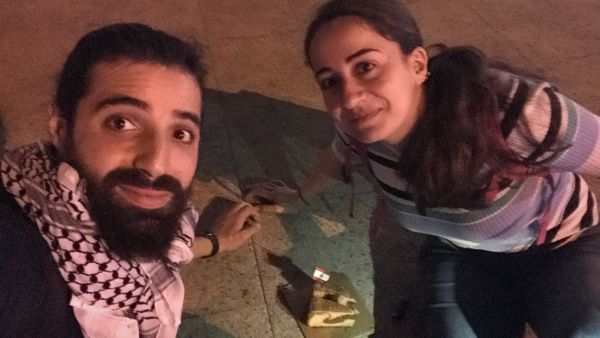
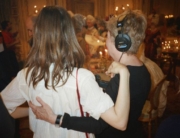
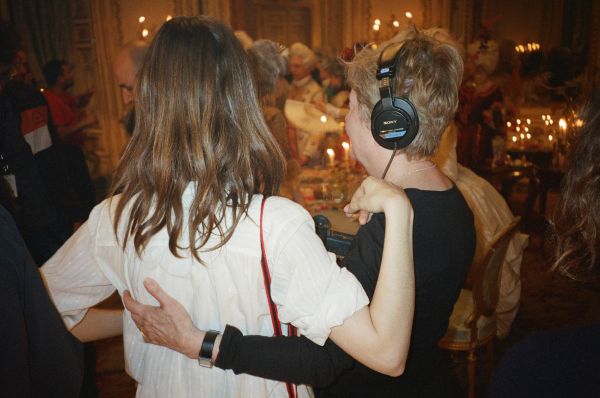
selfie in 2019 in Birds of War (Habak Films)
There is something immediately intimate, yet ominous, about the opening of Birds of War. The documentary establishes its emotional atmosphere before we have quite understood the circumstances: handheld footage, secluded roads at night, text messages exchanged across enormous distances. We are being admitted into a private world, but one in which intimacy is inseparable from danger. The people exchanging these messages are falling in love, though neither knows it yet, and one of them is living under bombardment.
The film, directed by and starring Lebanese journalist Janay Boulos and Syrian activist and videographer Abd Alkader Habak, follows the unlikely development of their relationship amid the Syrian revolution, the siege of Aleppo, and the long, disorienting aftermath of war and exile. Boulos, working for BBC Arabic in London, first contacts Habak to obtain footage from Syria. He is filming the devastation of Aleppo, documenting the Assad regime’s assault on the city and the increasingly desperate circumstances of its inhabitants. What begins as a professional exchange gradually becomes a friendship, then a romance, sustained through spotty internet connections, sporadic text messages, voice notes, and video calls.
The film’s great achievement is to make this personal history a point of entry into a much larger one. The Syrian revolution, the brutality of Bashar al-Assad’s regime, the Russian intervention, the destruction of Aleppo: these historical events were extensively covered as they unfolded. Yet amid the subsequent catastrophes in Ukraine and Gaza, and the relentless churn of political news during the Trump era, Syria’s recent history risks receding into a generalized memory of destruction. Birds of War restores its particularity by anchoring its recent history in a relationship that we watch develop. These events from a decade ago feel startlingly immediate.
Much of this effect comes from the extraordinary archive the couple has assembled. Habak’s footage ranges from scenes of almost unbearable violence to small assertions of ordinary humanity. Rescue workers scramble through bombed-out streets, carrying the wounded and the dead toward hospitals. In one harrowing sequence, a hospital comes under attack. Elsewhere, a man tends a garden on his rooftop, cultivating a little patch of life amid the ruins.
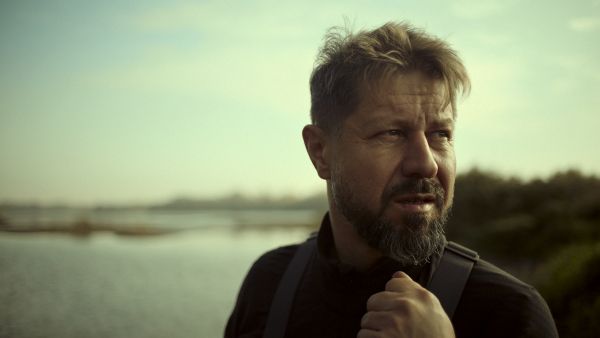
Habak, who looks a bit like the actor Oscar Isaac, is a compelling presence. Raised in Idlib, Syria, under a regime that cultivated fear and suspicion, he describes a youth marked by the constant awareness of surveillance. The uprising of 2011 changed everything, setting him on the path of activism as he began filming demonstrations and uploading videos to YouTube, participating in the revolution through the act of witnessing it. When the authorities started pursuing activists, he left his hometown of Ariha for the free city of Aleppo, partly to protect his family from reprisals.
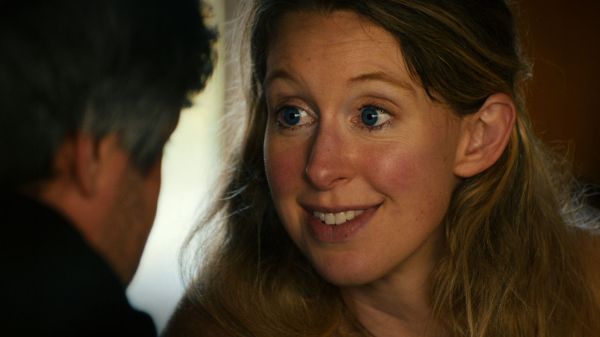
Boulos inhabits a radically different world. Originally from the peaceful, beautiful coastal Lebanese city of Byblos, she left Lebanon to pursue journalism. Working from London, she depends on people like Habak to document events that international reporters cannot safely access. The physical and psychological distance between their circumstances becomes one of the film’s recurring tensions. In a newsroom, she receives images of destruction that he produces at considerable personal risk. Yet their correspondence gradually dissolves the professional distance between the person requesting the footage and the person risking his life to obtain it.
Rather than simply recounting how they met, the filmmakers reconstruct the experience of getting to know someone through the materials of contemporary communication. We read their texts, hear their voice messages, watch their tentative video calls. The exchanges have the awkwardness, humor, curiosity, and gradually deepening tenderness of an actual courtship. Although we know the outcome, the romance unfolds before us. And because the relationship is so closely entangled with the war, the history itself acquires the same immediacy.
A particularly consequential moment comes in 2017, when Habak travels to document an evacuation and population exchange. A bomb explodes near a convoy, killing more than a hundred people, including dozens of children. A photograph of Habak carrying an injured child to safety circulates around the world, briefly making him an international symbol of compassion amid atrocity. Yet even this moment of apparent heroism carries a terrible irony: The publicity draws threats from armed extremists, further jeopardizing his safety.
What makes Birds of War so effective is its refusal to separate the historical from the intimate. The romance is not a diversion from the war, nor is the war merely a dramatic backdrop for the romance. Each gives the other its emotional weight. The camera that records a bombed hospital also records a budding relationship; the phone that receives reports of destruction also carries flirtation, affection, and the ordinary anxieties of two people trying to become close. The film not simply reminds us of what happened in Syria, but restores something of what it felt like to be alive while it was happening.


Leave A Comment